
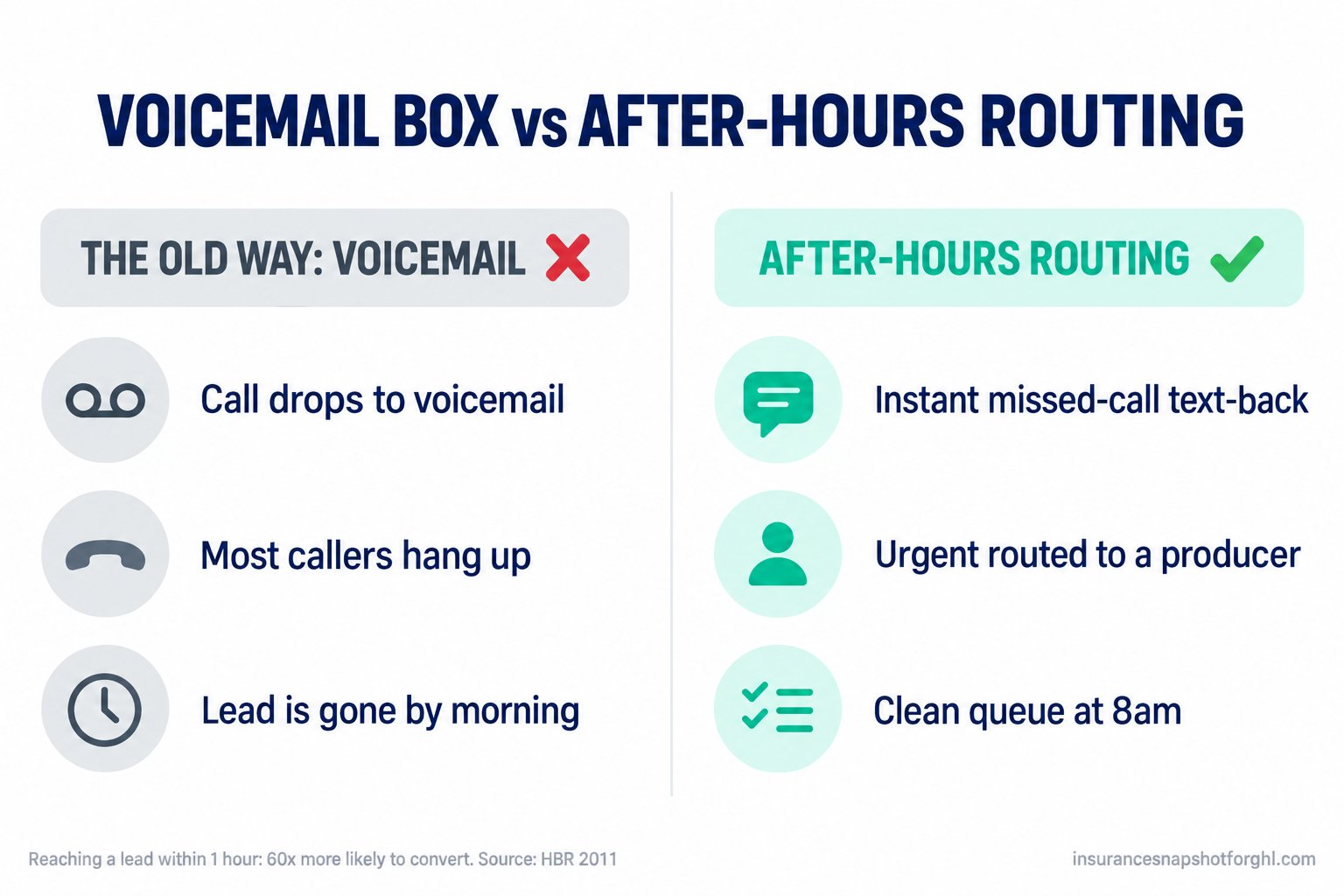
It is 8:40 on a Tuesday night. A driver just clipped another car and needs proof of coverage before the tow truck leaves. He Googles “auto insurance near me,” lands on your site, and calls. Your line rings four times and drops to voicemail. He hangs up, taps the next result, and by morning he is somebody else’s client. You never knew he existed. That is the after-hours leak, and it is the biggest hole in most agencies’ funnel nobody is watching.
Here is the answer: you do not need a night-shift CSR to plug it. You need a routing system that treats every after-hours contact as three questions, is this urgent, can it wait, or is it a quote, and sends each down the right path automatically. Six parts do it, shown above, and this post builds each one, with copy you can paste in tonight and the ways it breaks.
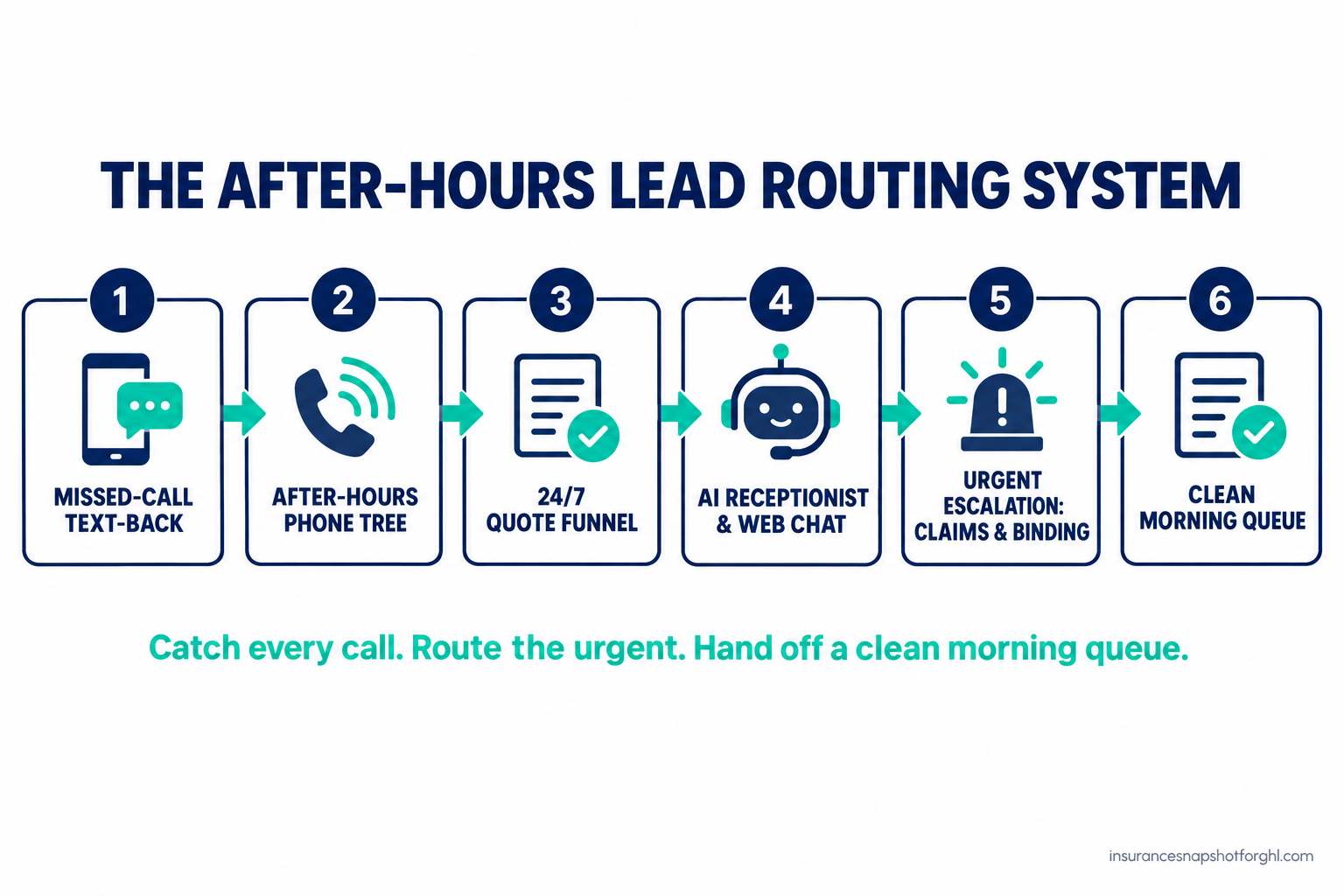
Table of contents
- What after-hours misses actually cost you
- Stage 1: Catch the hang-up with missed-call text-back
- Stage 2: Build a phone tree that routes, not just records
- Stage 3: Put a 24/7 quote intake funnel on your site
- Stage 4: Add an AI receptionist and web chat to triage
- Stage 5: Set the escalation path for claims and binding
- Stage 6: Hand off a clean morning queue
- Solo, five-producer, and large: who runs what
- The compliance layer: TCPA, quiet hours, and A2P 10DLC
- Objections
- Measure the leak, then close it
- FAQ
What after-hours misses actually cost you
People shop for insurance after work, on weekends, and the moment something goes wrong, a fender bender, a closing that needs a binder, a proof-of-renters request. Those moments do not respect your 8-to-5, so a real share of your new business hits the phone and the site when the office is dark, and if the only thing waiting is a voicemail box, most of it walks.
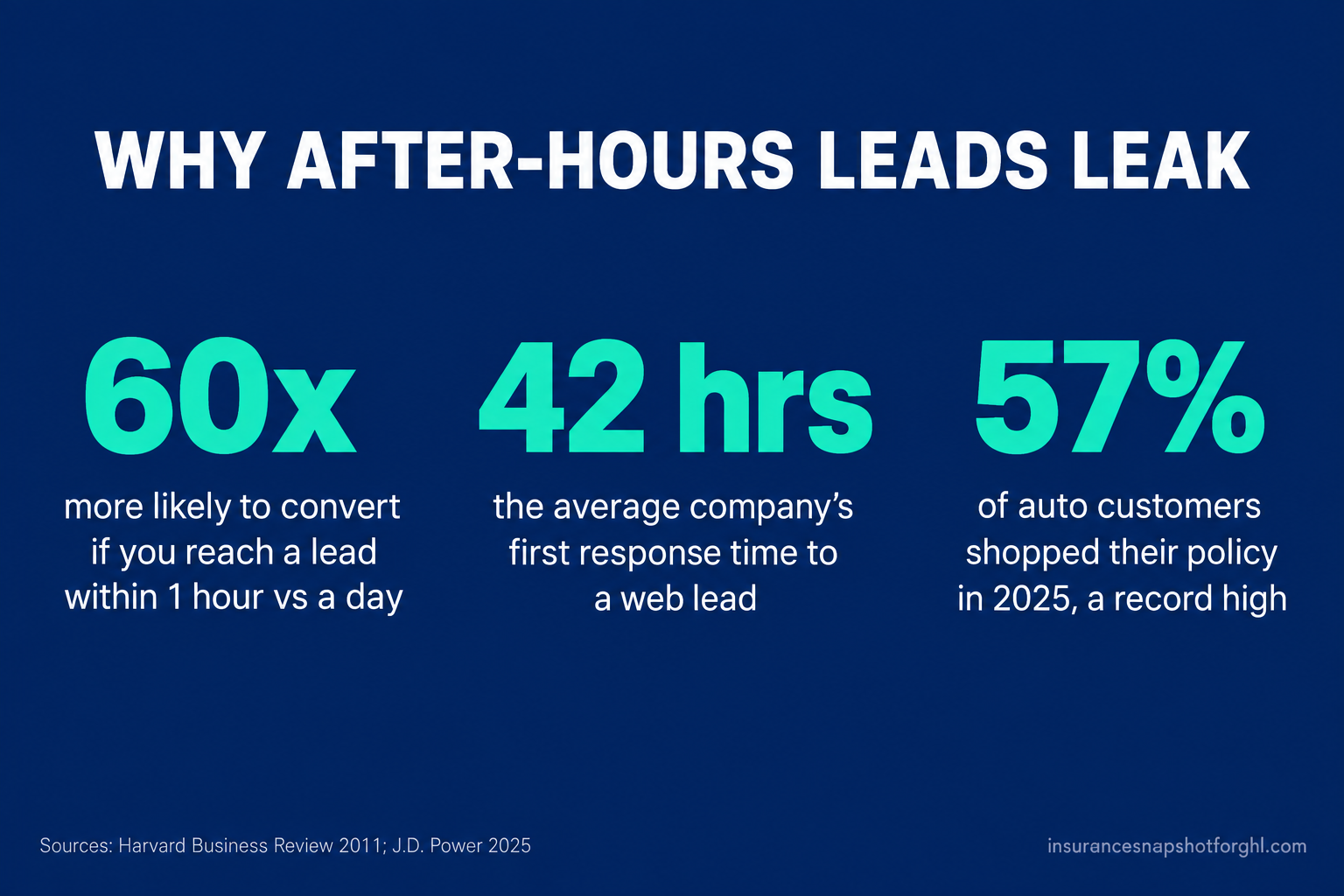
The cost is not abstract. The average company takes 42 hours to respond to a web lead, and nearly a quarter never respond at all, per Harvard Business Review’s audit of more than 2,000 firms (HBR). That same research found firms reaching a lead within an hour are 60 times more likely to have a real conversation than those who wait a day. Overnight your response time is eleven or twelve hours, and an unrouted lead is close to dead by the time you pour coffee. No one is sitting by the phone at 2am, so the catch has to be automated, not staffed.
Relative odds of a meaningful conversation with a decision-maker by speed of first contact: reaching a lead within an hour is 60x more likely to land one than waiting a full day. Source: Harvard Business Review, “The Short Life of Online Sales Leads” (2011).
The market makes it worse. A record 57% of auto customers shopped their policy last year, up from 49% (J.D. Power), often against direct writers who answer 24/7, while independent agents still place 61.5% of U.S. P&C premium (Insurance Journal). Retention runs near 84%, top shops at 93% to 95% (Agency Performance Partners), and lifting it five points can raise profit 25% to 95% (Bain & Company). So the system wins quotes and catches the client whose payment failed at 9pm, one call from shopping you.
Stage 1: Catch the hang-up with missed-call text-back
This is the highest-return automation you will turn on, and it takes about ten minutes. The rule: any inbound call not answered inside a set number of rings triggers an automatic text back, in seconds, from your business line.
Why it works: they still have the phone in their hand. A voicemail asks them to keep waiting; a text hands them a live thread they can answer with one thumb. The message identifies you, acknowledges the miss, and asks one easy question.
Hi, this is [Agency Name]. Sorry we missed your call, this line
texts back so we do not lose you. Are you after a new quote, or is
this about a current policy? Reply STOP to opt out.
That one question does the routing. “New quote” drops them into the quote pipeline; “current policy” flags a service item; “claim” trips the urgent path in Stage 5.
How it breaks: the text fires but nothing catches the reply overnight, so “yes, a quote on my truck” at 8:45pm hears nothing until morning. Better than silence, but you have only moved the leak. The fix is Stage 4 and Stage 6.
Stage 2: Build a phone tree that routes, not just records
Your after-hours greeting is doing routing work whether you designed it to or not. Most agencies waste it: “You’ve reached us. Our hours are 9 to 5. Please leave a message.” That sends a claim, a quote, and a billing question to the same dead box. Replace it with a short menu that sorts by urgency and gives every caller a path tonight.
Thanks for calling [Agency Name]. Our office is closed, but we do
not want you stuck.
- Claim or urgent need tonight? Press 1 to text a producer.
- New quote? Press 2 for a link to start now; we follow up first thing.
- Current policy? Press 3 or leave a message; we handle it in the morning.
You can also text this number any time.
Press 1 routes to Stage 5. Press 2 fires the quote link and tags the contact. Press 3 captures a service item. Every branch does something tonight.
How it breaks: the menu promises a live person on “press 1” and rings a producer with notifications off. An escalation path that reaches no one is worse than one that never promised anything. Only offer live escalation if you have an on-call rotation, and test it monthly.
Stage 3: Put a 24/7 quote intake funnel on your site
The phone is half your after-hours traffic; the other half never calls. They land on your site, and if the only option is a form that dumps into an inbox nobody reads until morning, they bounce to a direct writer that quotes instantly.
The fix is a real quote intake funnel: a short, mobile-first form that asks only what you need to start, line, ZIP, name, cell, best time, current carrier, and ends with a clear “what happens next.” The mechanics are in our guide to the insurance quote funnel. What makes it an after-hours weapon: it does not just store the submission, it fires an immediate acknowledgment and a follow-up sequence the moment they hit submit at 10:15pm:
Thanks [First Name], we've got your info for a [line] quote. A
licensed agent will review it and reach out [tomorrow morning]. If
it's urgent tonight, reply URGENT. Reply STOP to opt out.
Then a short sequence carries them to morning: a reminder at open, an email with what to have ready, and a producer task when the lights come on. The lead never sits in silence.
How it breaks: you ask for too much. A 14-field form at 10pm on a phone is where after-hours leads go to die. Ask the minimum to make contact and route to the right line; get the rest in conversation.
Disclosure: the GoHighLevel link above is an affiliate partner link; you pay the same price.
Stage 4: Add an AI receptionist and web chat to triage
Stages 1 to 3 catch the contact. This stage keeps it warm and answers the easy stuff so a human never has to. An AI receptionist, on the phone and in web chat, greets the caller, answers common questions (“do you write in my state,” “can you do renters tonight”), collects quote details, books appointments, and hands off when it is out of its depth. Setup is in the AI receptionist for insurance agencies guide, and the broader build in the GoHighLevel AI employee for insurance agencies.
The most important rule for an AI receptionist in insurance: it must never quote a premium, bind coverage, or advise on what a client should carry. Those are licensed-agent jobs, full stop. The AI collects and confirms; the producer quotes and advises. Write the guardrail into the prompt and test it by trying to make it quote you a number.
How it breaks: the bot pretends to be a person, or answers a coverage question it has no business answering. Both destroy trust. Have it identify as an assistant, cap what it will do, and route advice, claims, and complaints to a human. A humble bot beats a confident one that guesses wrong.
Stage 5: Set the escalation path for claims and binding
Most after-hours contacts can wait. A few cannot, and the system’s credibility rides on catching those few: a reported claim, a coverage question tied to an accident happening now, a same-day binding deadline.
Build a narrow rule so the system does not escalate everything (and burn out your producer) or nothing (and drop the one that mattered): any contact whose keyword or menu choice signals claim, accident, or same-day deadline. Everything else routes to the morning queue. When it trips, three things happen at once: the on-call producer gets a text with the caller’s name, number, and one-line reason; the caller gets a “we’re connecting you now” acknowledgment; and a backup is paged if the producer does not respond in time.
URGENT after-hours: [Name], [phone]. Reason: [claim / accident /
binding deadline]. Came in [time]. Reply CALLED once you reach them,
or IGNORE to bounce to backup.
For claims, remember you are not the carrier’s claims line. After hours, reassure the client, capture the basics, point them to the carrier’s 24/7 claims number, and log it. Do not adjust or promise anything.
How it breaks: scope creep. Within a month “urgent” means “any text after 6pm,” and producers stop answering the on-call phone. Keep the definition tight and review what got escalated each month.
Stage 6: Hand off a clean morning queue
The system’s last job is to make the morning easy. Every contact it caught should land in one prioritized queue the first person in can work top to bottom, not scattered across four separate tools.
Sort by urgency and age. New quote requests go first, because a competitor is chasing them this morning too; service items follow; anything the AI already handled gets a status so nobody double-touches it. Drop a producer task for each new-business lead with everything attached: line, contact, what they said, stage. This is where after-hours connects to your daytime cadence, the same discipline you use on renewals, covered in the renewal cadence that actually works.
MORNING QUEUE - [date]
NEW QUOTES (work first):
- [Name] - auto - 8:40pm missed-call text - "quote on my truck"
SERVICE (work next):
- [Name] - billing question via chat - needs callback
HANDLED OVERNIGHT (confirm):
- [Name] - proof-of-insurance - AI sent card 9:12pm
How it breaks: the pieces never connect, so the morning queue is really four queues in four tools and the CSR checks two of them. The whole point is one place to look. If your pieces do not feed one queue, you bought automation and kept the chaos.
Solo, five-producer, and large: who runs what
The framework is the same at every size. What changes is how much is a person and how much is automation.
Solo operator. You are the on-call producer, unsustainable if everything escalates, so lean hardest on automation. Turn on text-back, the quote funnel, and an AI receptionist that handles nearly everything, and set the urgent rule tight, claims and same-day binding only, routed to your cell. You sleep and wake to a short, sorted list, not 40 missed calls.
Five-producer agency. The sweet spot, and probably you. Run an on-call rotation so no producer carries every night. The AI handles first contact and triage; the phone tree and funnel feed a shared morning queue a CSR works at open; the escalation rule reaches whoever is on call, with a backup. Your coverage now looks like a direct writer’s at a fraction of the cost, which is what lets a five-person shop compete with a 24/7 call center.
Large agency (10-plus, multi-location). Volume is high enough that the queue needs structure: route by line or location, split personal from commercial, and make the rotation formal with backups and a service target. The risk is not too few contacts, it is contacts falling between departments, so routing and the single queue matter more, not less.
The compliance layer: TCPA, quiet hours, and A2P 10DLC
Everything above leans on texting, so the compliance layer is not optional. Get it wrong and the after-hours system becomes an after-hours liability. Three things to build in from message one (the full field guide is in TCPA-safe SMS for insurance agencies).
A2P 10DLC registration. U.S. business texting runs on the application-to-person 10-digit long code framework. Register your brand and campaign with the carriers before you send, or your messages get filtered and never arrive.
Consent and opt-out. Text only people who gave prior express consent, and honor STOP, HELP, and unsubscribe automatically. A text-back to a number that just called you is generally sound since they initiated contact, but keep the opt-out on it anyway.
Quiet hours. The TCPA restricts telemarketing to 8am to 9pm in the recipient’s time zone. Replies to someone who just contacted you are a different category, but outbound marketing should respect the window and hold until morning, not fire at 11pm.
One thing to be clear about, because outdated advice is everywhere: do not build your consent flow around the FCC’s “one-to-one” consent rule. The Eleventh Circuit vacated it on January 24, 2025, and the FCC removed the rule text later in 2025, so consent reverts to the prior standard (FCC).
Objections
“Won’t customers find an automated text annoying?” Not when it is fast, honest, and useful. An instant “sorry we missed you, quote or current policy?” reads as responsive, arriving while they still care. The annoying version pretends to be a person or blasts a pitch. Keep it short and it lands as service.
“I already pay for an AMS and a phone system. Isn’t this redundant?” Your AMS stores records and your phone routes calls, but neither texts a missed caller back, runs a quote funnel, or triages web chat overnight. This is a thin layer on top of what you have.
“What if the AI says the wrong thing?” That is a guardrail problem, solved by capping what the AI can do. It never quotes, binds, or advises, and a bot that says “a licensed agent will confirm that in the morning” is safer than a voicemail box that says nothing at all.
Measure the leak, then close it
You cannot manage what you do not count, so measure it: for one month, count how many calls and web submissions arrive outside business hours and how many turn into a real conversation. That capture rate is your baseline, and tracking after-hours quotes and bound policies gives you the honest ROI.
Go back to the driver who clipped a car at 8:40 on Tuesday. With this running, his call triggered a text back before he reached the next result. He replied “need proof of insurance and a quote,” the AI logged it, and a producer had his name at the top of the morning queue at 8:01am. He became yours, because the office being closed did not mean the door was locked. Speed is the whole game, and speed after hours is the part almost nobody has built.
FAQ
How do I capture insurance leads that come in after business hours?
Use a routing system, not a night-shift hire: missed-call text-back on every unanswered call, a 24/7 quote intake funnel, an AI receptionist and web chat to triage, an escalation rule that reaches an on-call producer only for claims and same-day binding, and one prioritized morning queue for everything else.
What should a missed-call text-back say?
Keep it short and route with one question: identify the agency, acknowledge the miss, and ask whether they want a new quote or help with a current policy, with a STOP opt-out. The answer tells your system where to send them.
Is it legal to text a customer back automatically after hours?
Yes, with the right setup: A2P 10DLC registration, prior express consent, and a working opt-out on every message. A text back to a number that just called you is generally sound because they initiated contact. Respect the 8am to 9pm quiet-hours window for outbound marketing, and do not rely on the FCC one-to-one consent rule, which was vacated in 2025.
Should an AI receptionist quote insurance prices after hours?
No. It should never quote a premium, bind coverage, or give coverage advice, those are licensed-agent decisions. The AI collects details, answers documented questions, books appointments, and escalates anything urgent or advisory to a human.
What counts as an urgent after-hours contact worth escalating?
Keep it tight: a reported claim, a coverage question tied to an accident happening now, or a same-day binding deadline. Everything else, quotes, billing, general service, waits for the morning queue.