
It is 4:50 on a Thursday and you just emailed a clean homeowners quote to a prospect who called in hot two days ago. They said it looked good, they would “talk to the spouse,” and they would call back. They have not, and your gut says they will not. The quote is sitting in their inbox next to two others, and whichever agent texts them first Saturday morning binds it. It will not be you, because your follow-up ended the second you hit send.
Here is the answer up front: the quote is not the finish line, it is the starting gun. A quote that gets one follow-up is one you are donating to a competitor. The fix is a fixed, automated sequence of seven touches over 21 days that fires the moment a quote goes out, mixes text, email, and a real phone call, and keeps going until the prospect binds, opts out, or goes cold. It runs on the GoHighLevel system you already have, works the same for auto, home, or commercial, and you can build it this week. This post is the build, touch by touch.
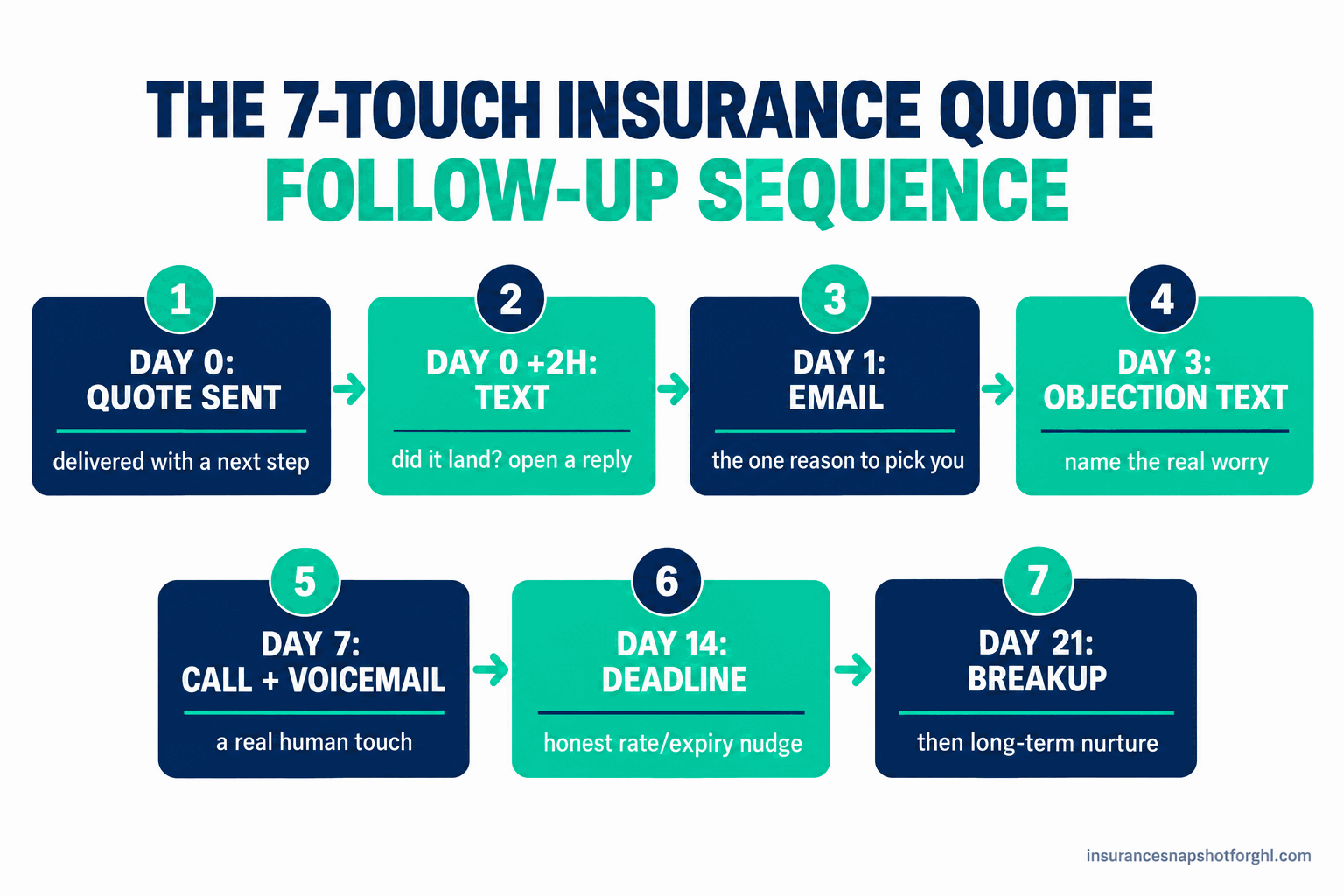
Table of contents
- What a cold quote actually costs you
- The sequence at a glance: 7 touches, 21 days
- Touch 1 (Day 0): the quote delivery that sets up the follow-up
- Touch 2 (Day 0, +2 hours): the “did it land” text
- Touch 3 (Day 1): the reason to pick you
- Touch 4 (Day 3): pre-empt the real objection
- Touch 5 (Day 7): the human call plus voicemail
- Touch 6 (Day 14): the honest deadline
- Touch 7 (Day 21): the breakup
- Solo, five-producer, and large: who runs what
- The compliance layer you cannot skip
- Objections
- The quote that does not go quiet
- FAQ
What a cold quote actually costs you
Every quote already cost you money: a call, a rater run, a check on carrier appetite, a written proposal, win or lose. A quote that goes quiet is a loss you already paid for, and you are not the only agent who paid it. Shoppers collect an average of 3.5 quotes before they buy, the highest in the history of the J.D. Power study, with auto shopping still near a record 53% of customers (J.D. Power). Independent agents place 61.5% of all U.S. property and casualty premium (Insurance Journal), much of it in small shops where follow-up is whatever the producer remembers. The prospect is not choosing whether to buy. They are choosing which of the agents they talked to keeps showing up.
Share of U.S. auto-insurance customers who shopped their policy, by study year. Still near record highs, so your quote is sitting next to several others. Source: J.D. Power U.S. Insurance Shopping Study, 2025 and 2026.
The persistence math is the part agencies get wrong. In a Velocify study of about 3.5 million leads, 93% of the leads that eventually converted were reached by the sixth contact attempt (National Law Review). Yet secret-shopper research into online lead response routinely finds teams averaging barely more than one call per lead before giving up (Cirrus Insight). That gap, between the six attempts it takes and the one or two most agencies make, is where your bind rate is hiding.
The sequence at a glance: 7 touches, 21 days
Seven planned touches fire automatically off one trigger: a quote marked “sent” in your pipeline. It blends channels on purpose, because a prospect who ignores a text opens an email, and the one who ignores both picks up a call. Only the Day 7 call needs a human; the rest runs itself. The timeline maps all seven.
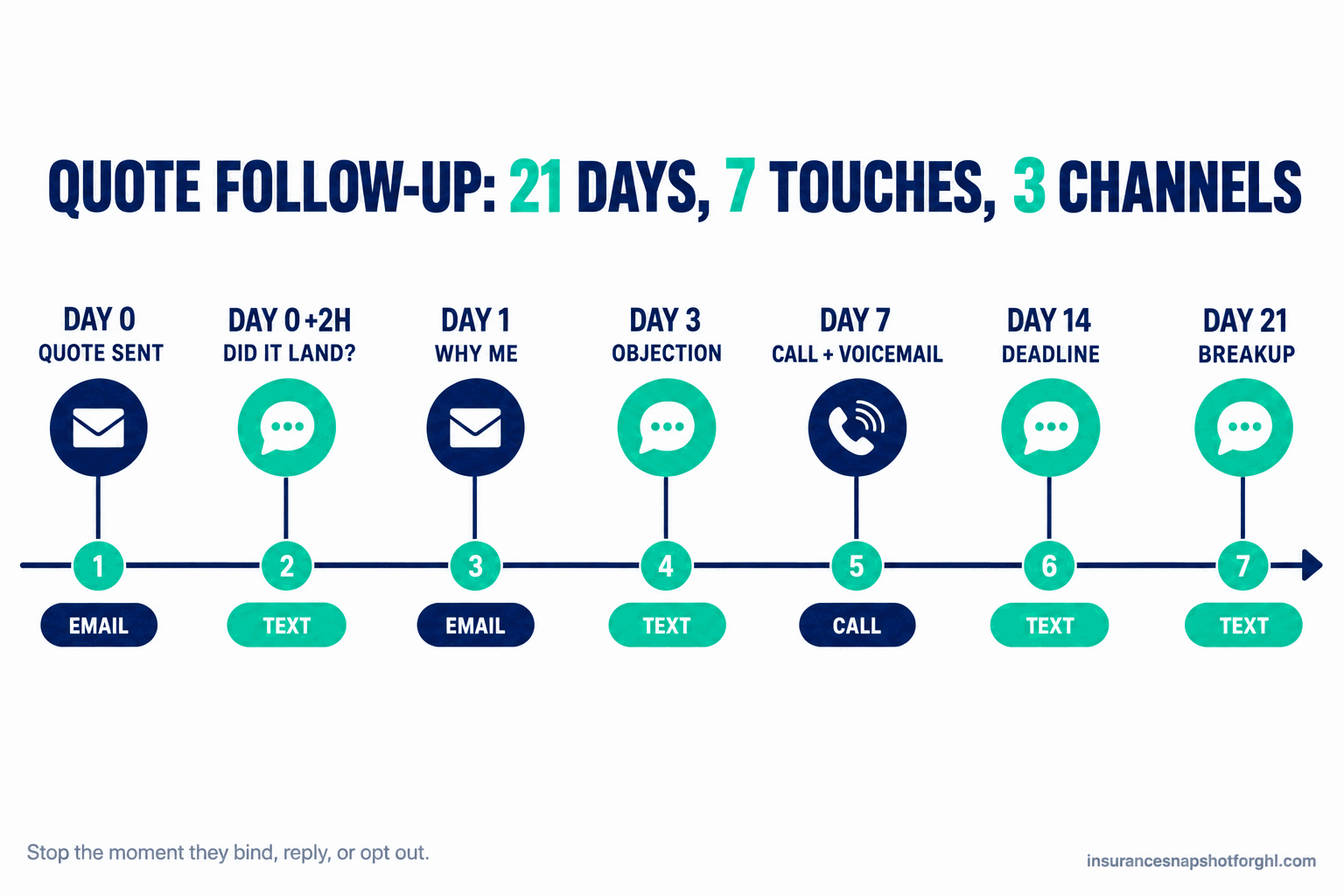
It sits downstream of intake: if leads are not arriving fast and clean, fix that first with a real insurance quote funnel and a speed-to-lead response. This sequence takes over once the quote is out the door.
Touch 1 (Day 0): the quote delivery that sets up the follow-up
The follow-up starts in how you send the quote. A PDF dumped with “here you go, let me know” gives you nothing to work with. Deliver it with a next step baked in: a specific question and a time, like “I’ll check in Tuesday if I haven’t heard back.” Now the later touches are not nagging, they are you doing what you said.
How it breaks: you send three carrier options with no recommendation. A confused prospect stalls, and a stalled prospect shops. Give them your pick and your reasoning, so the sequence has something to reinforce.
Touch 2 (Day 0, +2 hours): the “did it land” text
Two hours after the quote goes out, a short automated text fires. Its only job: confirm the quote arrived and open a reply thread, because a prospect who texts back once is easier to reach later.
Hi [first name], it's [producer] at [agency]. Just sent your [auto/home]
quote over by [email/text] a couple hours ago. Did it come through okay?
Happy to walk through any of it. Reply STOP to opt out.
The question mark matters: a question gets replies, a statement gets ignored. When they reply, the automation pauses the sequence and drops a task on the producer, because a live conversation beats a scheduled message.
How it breaks: the text fires before the quote email sends, so the prospect gets “did it land?” before anything landed. Order the quote-sent step first, then the two-hour timer, and test it on your own phone first.
Touch 3 (Day 1): the reason to pick you
Day 1 is an email that does the job price cannot: it gives them a reason to choose you over the cheaper quote in the next tab. Your edge as an independent is not the lowest number, it is that you shop multiple carriers, handle the claim call, and answer the phone. Say that plainly.
Subject: One thing to know before you decide

Hi [first name],

Quick note on the [line] quote. The number matters, but here is what it
does not show: I placed it with [carrier] for how they handle [claim type]
claims, and if you ever file one, you call me, not an 800 number. I also
re-shop your coverage every renewal, so you are not doing it yourself.

Want to walk through it on a quick call? Reply with a time.

[producer], [agency]
How it breaks: you lead with “just following up” and nothing else, which teaches the prospect to ignore you. Every touch has to carry one new, useful idea.
Touch 4 (Day 3): pre-empt the real objection
By Day 3 the prospect has usually decided something, they are just not telling you: the price felt high, they found a cheaper number, or they got busy. A text that names the likely objection gives them an easy opening.
Hi [first name], [producer] here. No pressure at all on the [line] quote.
If the price came back higher than you expected, tell me, there are a few
coverage levers we can pull before you decide. If you found something
cheaper, send it over and I'll tell you honestly how it compares. Reply
STOP to opt out.
Offering to review a competitor’s quote sounds backwards, but the cheaper quote is usually cheaper because it is missing coverage, and you are the only agent willing to read it with them. That builds the trust that binds.
How it breaks: you send the same objection text to every line. A commercial prospect weighing a BOP has different worries than someone shopping auto. Segment by line so the objection you name is the one they have.
Touch 5 (Day 7): the human call plus voicemail
A week in, a person steps up. Day 7 is a real phone call from the producer who owns the relationship, because most binds happen on a later attempt and a live voice carries the ones a text never will. The automation does not make the call, it makes sure it happens, by dropping a task with full context on the producer’s list.
Half of these calls go to voicemail, so the voicemail is planned:
Hi [first name], it's [producer] from [agency], about your [line] quote. No
rush. I just want to make sure you have what you need to make a good call,
and I'd rather you hear it from a person than get another email. I'll text
you right after this. Talk soon.
Right after the voicemail, an automated text fires so your number is in their phone: “Just left you a voicemail about your [line] quote, it’s [producer] at [agency]. Call or text anytime.” The call and text together convert far better than either alone. If the producer is slammed, an AI caller can place the first-pass call and route the live ones to a human.
How it breaks: the task lands in a shared queue nobody owns, so it never gets made. Route it to the producer who wrote the quote, and flag any Day 7 task still open at Day 9.
Touch 6 (Day 14): the honest deadline
Two weeks in, you need a real reason to decide now, and insurance gives honest ones: the quote may expire, the carrier may be filing a rate change, the effective date is getting close. Use the true deadline, never a fake one.
Hi [first name], [producer] at [agency]. Heads up: the [line] quote I sent
is good through [date]. After that I'd need to re-run it and the number
could move. If you want to lock it in, reply and I can bind it today.
Reply STOP to opt out.
How it breaks: you invent urgency. If the quote does not actually expire on that date, do not say it does; one fake deadline costs you all the trust the other touches built. No real deadline? Use a softer true one: “I’m updating my open quotes this week and wanted to check where you landed.”
Touch 7 (Day 21): the breakup
Three weeks of touches and still nothing means it is time for the message that, oddly, pulls the most replies of all: the breakup. Telling them you will stop removes the pressure and shakes loose the ones who meant to respond.
Hi [first name], [producer] here. I don't want to keep filling up your phone,
so this is my last note on the [line] quote. If the timing isn't right, no
problem at all, I'll close it out. If you still want to move forward, just
reply "yes" and I'll pick it right back up. Either way, thanks for giving me
a shot. Reply STOP to opt out.
Day 21 is not a dead end. A prospect who did not bind is early, not worthless. Tag them into long-term nurture, a monthly value email and an x-date reminder before their current policy renews, so you are the first call next time. The full engine is in our database reactivation playbook, and the renewal side lives in the renewal cadence that works.
How it breaks: you delete the lead or let it rot with no next step. The quote that went quiet today is a warm lead in eleven months when their renewal lands with a rate hike. Keep it.
Solo, five-producer, and large: who runs what
The seven touches do not change. Who handles the exceptions does.
The solo agent. You are the bottleneck this removes. Automate every touch except the Day 7 call, and protect your calendar so the only things that interrupt your day are that call and any reply. Every quote gets a full seven-touch follow-up without you remembering one. You are losing quotes purely because you ran out of hours, and this buys them back.
The five-producer shop. Routing is everything. Assign each quote to the producer who wrote it, drop the Day 7 task on that same person, and never let a reply land in a queue nobody watches. Add a manager dashboard for quotes sent with no follow-up activity, because this is where leads quietly die between producers. A shared CRM and workflow setup keeps the hand-offs clean.
The larger or multi-location agency. Segment hard by line and office. Personal auto and commercial need different objection copy, deadlines, and call cadences. Push every outcome back into the system of record so reporting shows which office converts quotes. At your volume, a two-point lift in quote-to-bind is a full producer’s worth of premium.
The compliance layer you cannot skip
This sequence texts and calls prospects, so set the rules up first.
A2P 10DLC. Business texting over a 10-digit number requires registering your brand and campaigns through The Campaign Registry, or carriers filter and block your messages (Microsoft Learn). Register before you launch.
TCPA consent and opt-out. You need prior express consent and a working opt-out on every message, which is why every text above ends with STOP. One thing people misread: the FCC’s one-to-one consent rule never took effect. The Eleventh Circuit vacated it on January 24, 2025, and the FCC removed the rule text in 2025 (FCC). That is not a green light to text cold lists. The full field guide is in TCPA-safe SMS for insurance agencies.
Anti-rebating and endorsements. If a follow-up ever drifts into offering a gift to decide, watch your state’s anti-rebating limits (Florida caps client gifts near $100 a year, Texas near $25). If you sell life or annuities and lean on testimonials, NAIC Model 570 requires them to be genuine and to disclose any paid endorsement (NAIC). Put the guardrails inside the templates, not in someone’s memory.
Objections
“Seven touches feels like harassment. Won’t I annoy people?” Annoyance comes from useless repetition, not persistence. Each touch carries a different, useful idea on a different channel, and the sequence stops the instant they reply, bind, or opt out. A prospect who collected 3.5 quotes expects follow-up; the agent who vanishes after one email is the one who looks like they do not care.
“My producers say they already follow up.” Ask how many touches a quote gets before they give up. The honest answer is usually one or two, exactly where the Velocify data says most binds sit unreached. Automating the routine touches does not replace judgment, it frees their energy for the Day 7 call that closes.
“Do I need to be technical to build this?” No. It is one trigger (quote marked sent) and seven scheduled steps, six of them a text or email you write once and reuse. If you would rather not wire it yourself, it ships pre-built and installs in about a day.
The quote that does not go quiet
Go back to that Thursday homeowners quote. With this sequence running, the prospect got a confirmation text two hours later and replied, the “here is why me” email Friday, and on Day 3 a note offering to read the cheaper quote they found. On Day 7 the producer called, left the voicemail, and the text landed with it. The prospect called back that evening, because by then you were the only agent still showing up, and their cheaper quote turned out to be missing wind coverage. You bound it. The quote you used to lose to silence is the one you keep, and none of it depended on you remembering.
FAQ
How many times should I follow up on an insurance quote?
Plan for seven touches over about 21 days, mixing text, email, and one real phone call. Velocify found 93% of converted leads are reached by the sixth attempt, so stopping after one or two leaves most of your binds unreached. Stop the sequence the moment the prospect binds, replies, or opts out.
What should the first follow-up after sending a quote say?
A short text about two hours after the quote, confirming it arrived and asking if it came through okay. A question gets a reply and opens a thread, which makes every later touch easier. Always identify your agency and include a STOP opt-out.
When should a human call instead of an automated message?
On Day 7. Automation handles the routine text and email touches, but the mid-sequence call is where most deals are won, so route it to the producer who wrote the quote, with a planned voicemail and an automated text right after.
Is it legal to text prospects about their insurance quote?
Yes, with prior express consent, a working opt-out on every message, and A2P 10DLC registration for your texting number. The FCC one-to-one consent rule was vacated by the 11th Circuit on January 24, 2025 and removed by the FCC that year, so consent reverts to the prior standard. Do not text cold-purchased lists.
What do I do with a quote that never binds?
Do not delete it. Tag it and move it into long-term nurture, a monthly value email and an x-date reminder before their current policy renews, so you are the first agent they call next time. Today's cold quote is often next year's bind.
Can I build this on my existing agency management system?
Your AMS stores the quote, but the follow-up runs best in a dedicated automation layer like GoHighLevel that handles two-way texting, scheduled email, call tasks, and STOP handling. It sits on top of whatever AMS you run.