
It is a Monday in the first week of the month and a producer forwards you an email from a carrier. Their appointment has been terminated, not for production or conduct, but because their resident license quietly expired eleven days ago and nobody renewed it. Every quote they were mid-stream on is frozen. A missed date on a calendar just became a revenue problem.
Here is the answer up front. For almost every U.S. agency, a resident producer license runs on a two-year cycle, renews online through NIPR, and requires continuing education completed before you can renew. The near-universal rule is 24 CE hours every two years, 3 of them ethics, though the real number depends on your state, your lines, and how long you have been licensed. The renewal is the easy part. What hurts an agency is missing the date, because when a license lapses the carrier appointments attached to it usually go too, and getting both back is slower and costlier than the renewal ever was.
This is general education, not legal advice. Confirm your own state and line with your insurance department, your carriers, and NIPR before relying on any number here.
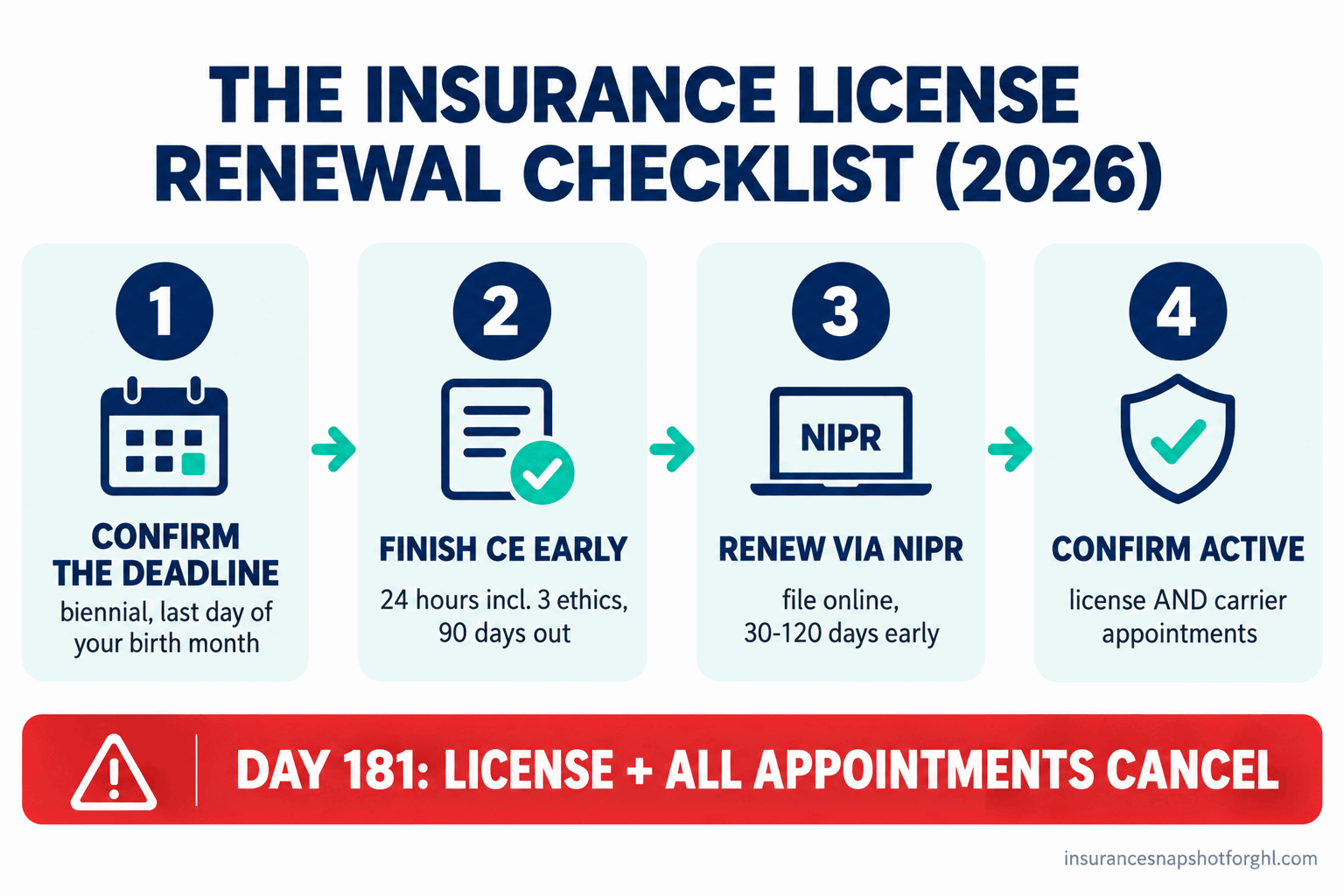
Table of contents
- What license renewal and CE actually involve
- What a lapse actually costs you
- How the renewal and CE mechanics work everywhere
- CE hours by state: why the number is not the same everywhere
- The renewal calendar: the dates that actually bite
- Steal this: the CE and license tracking system
- How a lapse actually happens
- Solo, five-producer, and multi-state: who tracks what
- The compliance layer most owners forget
- Where automation fits
- Objections
- The renewal you never think about again
- FAQ
What license renewal and CE actually involve
A resident producer license is your state’s permission to sell, solicit, and negotiate insurance, and it is not permanent. Every state makes you renew on a fixed cycle, and before you can, you must prove you completed continuing education. Those are two obligations, not one: CE is the homework, renewal is the paperwork, and the homework has to be done and reported before the paperwork goes through.
A third piece matters more for the agency: the carrier appointment, which authorizes you to write a carrier’s business and rides on your license. If the license goes away, the appointment usually goes with it, and that is what turns a clerical miss into lost revenue.
What a lapse actually costs you
The renewal fee is small, $30 to $200. The cost of missing it is not.
Start with production. The day your license is inactive you cannot legally sell, service, or advise, and transacting anyway invites fines and discipline. Any quote in progress moves to another licensed producer or stops, and for a solo principal it stops.
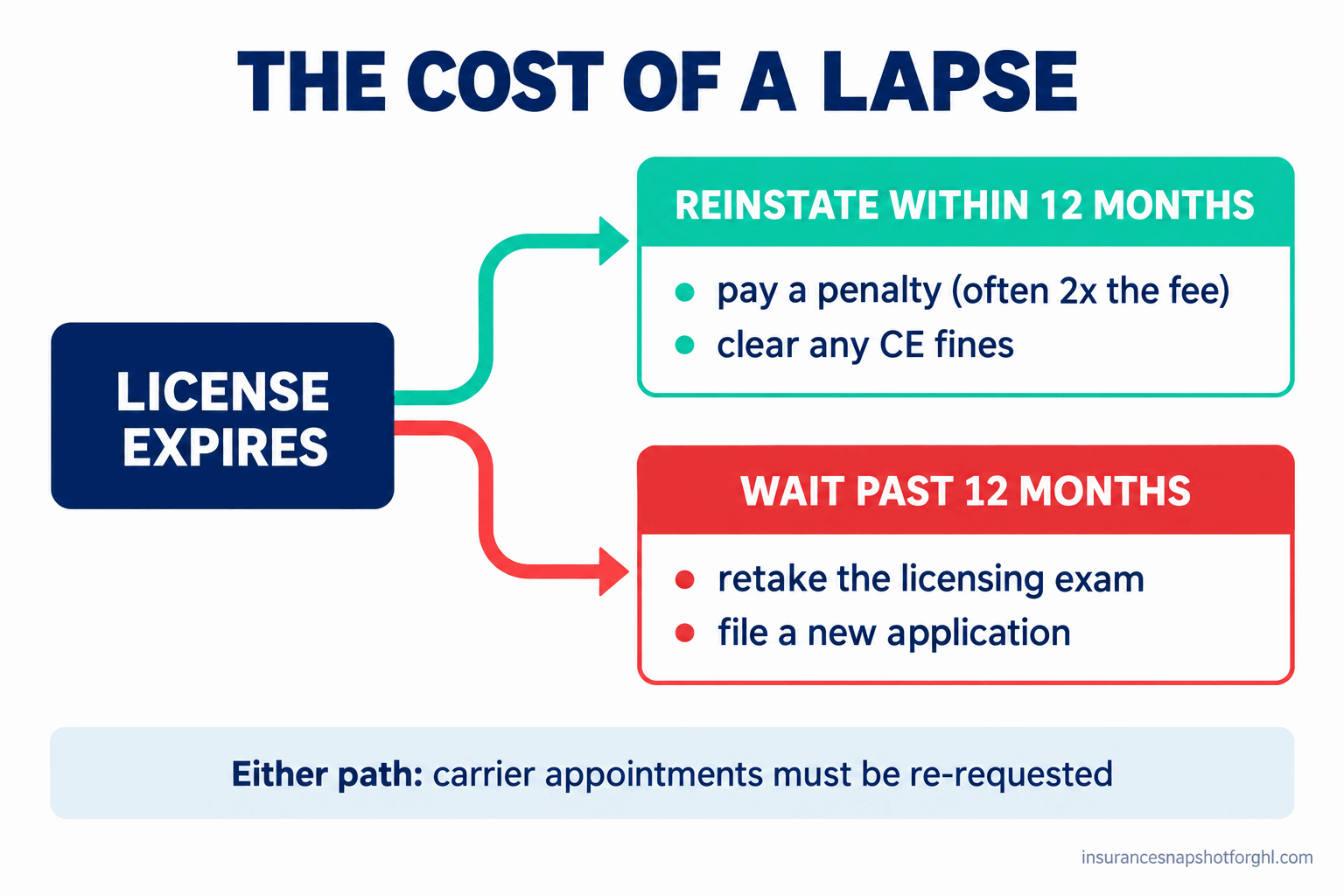
Then the appointments. If you have not completed CE and renewed inside the grace window, the license and all appointments cancel around day 181, and reinstating the license does not automatically bring them back: the carrier has to re-appoint you.
Then the money. Inside a 12-month window most states let you reinstate without re-testing, but you pay a penalty, often twice the unpaid fee, plus any CE fines; Texas charges $50 per deficient CE hour, up to $500 (TDI). Let the license sit expired more than a year and many states make you retake the exam and file a new application as if you had never been licensed (TDI). None of this is exotic: the 568,800 insurance sales agents nationwide (BLS), who place most U.S. P&C premium (Insurance Journal), all run on the same treadmill.
How the renewal and CE mechanics work everywhere
A few mechanics are close to universal. Learn these and the state differences become details, not surprises.
The term is almost always two years, tied to a date you do not pick, usually the last day of the producer’s birth month.
CE must be completed and reported before you renew. The provider reports your hours and the renewal system checks they are on file. If they are not reported yet, the renewal bounces even though you “did” the CE, so finishing weeks early, not days, is the safe habit.
You renew through NIPR, early. Most states open renewals 30 to 120 days before expiration and let you file online (NIPR). Satisfy your home-state CE and you generally satisfy your non-resident licenses too, through reciprocity verified against the NIPR Producer Database, though you still renew and pay for each.
CE hours by state: why the number is not the same everywhere
The “24 hours, 3 ethics” rule is the right default and holds in most states. But assume it is 24 everywhere and you will either over-buy courses or come up short in a state with its own rule. Here is how five representative states differ.
CE hours required per two-year cycle for a resident producer; standard is 24 (3 ethics). Sources: California (ExamFX), Texas (TDI), Florida (Aceable), Ohio (AgentSync), New York (Aceable).
| State | Hours / 2 yrs | Ethics | Renewal timing | The catch |
|---|---|---|---|---|
| California | 24 (20 limited-lines auto) | 3 | Anniversary month of first license | 90-day reminder; age-70 veterans can be exempt (CDI via ExamFX) |
| Texas | 24 | 3 | Last day of birth month | 12 hrs classroom-equivalent; $50 per deficient hour (TDI) |
| Florida | 24 under 6 yrs, 20 after | In Law & Ethics course | Last day of birth month | Hours drop with tenure; Law & Ethics course is license-type specific (Aceable) |
| Ohio | 24 | 3 | Last day of birth month | Carry over up to 12 excess credits (AgentSync) |
| New York | 15 single, 30 dual | 3 | Varies by license | Includes 1 hr insurance law, 1 hr diversity & bias (Aceable) |
The takeaway: the moment you write business, or hire a producer licensed, in a state you do not live in, look up its rule instead of assuming.
The renewal calendar: the dates that actually bite
Run renewal as a sequence, not a single due date, so you act at the first marker, not the last. Count back from expiration day.
- 1120 days out
Confirm the real deadline
Check the expiration date and the state's CE rule in the NIPR Producer Database. The birth-month rule catches people who assumed year-end.
- 290 days out
Finish the CE
Complete and report every required hour so the provider's reporting lag clears in time.
- 360 days out
File the renewal through NIPR
A rejected transaction or missing CE report is now a problem you fix with weeks to spare.
- 4Expiration day
Confirm active, not just submitted
A submitted renewal is not an active license. Verify the license and every appointment show active in the PDB.
- !Day 181 (the cliff)
License and appointments cancel
Miss the grace window and the license plus every appointment cancels. Reinstatement means penalties, and after 12 months, often the exam again.
The first four markers are cheap; the fifth costs real money, and you only reach it when the first four had no owner.
Steal this: the CE and license tracking system
You do not need new software, just one source of truth for every license and an early-warning cadence that is not a person’s memory. Here is the system, copy-ready.
The spreadsheet version works, but it depends on a human opening it every month, forever, which is the dependency that fails in a hard-market crunch or right after a hire.
How a lapse actually happens
Nobody decides to let a license expire; it happens through a handful of repeatable gaps. Here is each one, and how to close it.
The birth-month surprise. The owner assumes renewals land at year-end like taxes, but the due date is the last day of the producer’s birth month, and a July birthday buries a July deadline in a busy summer. Close it: record each license’s issue date and let the system calculate the due date.
The CE reporting lag. The producer finishes 24 hours on the last weekend and renews, but the provider has not reported the hours yet, so it rejects. Close it: finish CE 90 days out, and treat “completed” and “reported” as two different checkboxes.
The non-resident blind spot. A non-resident license in a state you write a little business in is forgotten, lapses, and you lose the right to service clients there. Close it: one row per license, resident and non-resident alike.
The new hire nobody set up. A producer joins mid-cycle, the license is active today, and eighteen months later it renews with no reminder because it was never entered. Close it: the onboarding step above, on day one.
The missing appointment link. An earlier lapse cancelled an appointment, nobody re-requested it, and the producer is now licensed but cannot write that carrier. Close it: track appointments against the license, and after any lapse confirm each is active again.
Every one of these is a tracking failure, not a knowledge failure. The producer knew they had to renew; the system just never surfaced it in time.
Solo, five-producer, and multi-state: who tracks what
The rules are identical at every size. What changes is who owns the tracking and how badly a miss scales.
The solo operator. You are the licensee, the tracker, and the person who gets buried in a hard market. Your risk is that the one license the agency runs on expires because you were too busy writing business to renew the right to write it. Keep the tracker to your own license, set the reminders to hit your phone, and finish CE a full quarter early.
The five-producer agency. Your risk is inconsistency. One producer renews like clockwork, another treats CE as a last-weekend emergency, and you inherit the exposure of your least organized teammate. Centralize the tracker so renewals are an agency function, make the 7-day escalation come to you, and standardize the course provider.
The multi-state agency. Your constraint is volume across jurisdictions: different due dates, hour counts, and mandatory topics at once, plus a web of non-resident licenses. Spreadsheet-by-hand breaks here. You need the tracker to hold every license and appointment, reminders that fire automatically, and a monthly review that catches the non-resident license nobody writes much through.
The compliance layer most owners forget
Renewal is the obvious obligation, but an active license does not make the rest of your conduct compliant. A few adjacent rules belong on the same checklist.
Advertising and testimonials. If you sell life or annuity products, the NAIC Model 570 requires testimonials to be genuine and current and paid endorsements disclosed as paid, which constrains the review-and-referral automation agencies love to switch on. See what you can legally automate.
Anti-rebating. Client-appreciation gifts and referral incentives are capped by state, and the caps differ sharply, so a thank-you that is fine in one state can be a violation in another.
TCPA and E&O. The reminder cadence above sends texts, so it lives under TCPA and A2P 10DLC; get consent and STOP handling right first with our TCPA-safe SMS field guide. And the discipline that keeps renewals on time is the same one that wins an E&O claim: a system that records the date and acts on it.
Where automation fits
License renewal is a date problem, and date problems are what automation is good at. The system is three parts: a record of every license with its due date, a reminder cadence that counts down on its own, and an escalation when a deadline nears and the work is not done.
When a producer’s renewal date is stored, a workflow fires the 120-day heads-up, the 90-day CE check, the 30-day warning, and the 7-day escalation, by text and email, without anyone opening a spreadsheet. That is the quiet second job of a done-for-you setup like the Insurance Snapshot for GHL, built on the 120/60/30/7-day renewal cadence that keeps policies on the books. Point it at your producers’ license dates instead of your clients’ policy dates and it becomes the cheapest lapse insurance your agency will ever run.
Objections
“My producers are adults, they can track their own license.” They can, right up until the month they are slammed and it slips, and then it is your agency that cannot write that carrier. Tracking it centrally is not babysitting; it protects the agency from one person’s bad week.
“I have renewed the same way for fifteen years and never lapsed.” That is a good streak, not a system. The agencies that get caught relied on memory because memory had always worked, until a birth-month deadline collided with a hard-market scramble.
“Setting this up is more work than just renewing.” The setup is a one-time afternoon: enter the licenses, set the dates, turn on the reminders. After that it runs with zero effort, far less than the annual fire drill of chasing CE in the final week.
The renewal you never think about again
Picture that Monday again, but this time the carrier email never comes. Ninety days before the producer’s birth month a text went out with the CE link, they finished the hours, the provider reported them, and sixty days out the renewal filed clean through NIPR. On the expiration date the license and every appointment showed active, and nobody spent an anxious hour on it.
That is the whole goal. Renewal and CE are not hard, just easy to forget and expensive when you do, the exact profile of a task that should never depend on a human remembering. Build the tracker and set the countdown.
Read how to automate renewal reminders without upgrading your AMS and the small-agency playbook for hiring a producer next, both built on the same idea: let a system own the dates so your people can own the relationships.
FAQ
How often do I have to renew my insurance license?
In most states a resident producer license runs on a two-year cycle and renews on the last day of your birth month. California is a common exception, tying renewal to the anniversary month of your first license. Confirm yours in the NIPR Producer Database.
How many continuing education hours do insurance agents need?
The most common requirement is 24 hours every two years, 3 of them ethics. It is not universal: New York requires only 15 hours for a single-line producer, Florida drops from 24 to 20 after six years licensed, and several states add topics such as insurance law. Check your state and lines.
What happens if my insurance license expires?
You can no longer legally sell, service, or advise, and the carrier appointments attached to the license usually cancel with it, around day 181. Inside a 12-month window most states let you reinstate by paying a penalty and clearing any CE deficiency; after 12 months, many make you retake the exam as if newly licensed.
Does completing CE in my home state cover my non-resident licenses?
Generally yes. Most states satisfy non-resident CE through reciprocity once your home state verifies you are compliant, checked against the NIPR Producer Database. You still renew each non-resident license and pay each fee, so track every license as its own line.
How early can I renew my insurance license?
Most states open renewals 30 to 120 days before expiration, filed online through NIPR. Finish CE about 90 days out and file the renewal around 60 days out, which leaves time to fix a reporting lag before the deadline.
Related posts
- How to Automate Insurance Renewal Reminders Without Upgrading Your AMS
- Insurance Marketing Compliance: What You Can Legally Automate
- How Much E&O Insurance Does a Small Insurance Agency Actually Need?
- Hiring an Insurance Producer: The Small-Agency Playbook for 2026
- TCPA-Safe SMS for Insurance Agencies: A Field Guide