
For a Charlotte insurance agency, comment-to-DM automation is the fastest way to stop losing quote-ready shoppers on social — it detects a coverage question in your Facebook or Instagram comments, replies in seconds, moves the conversation into a private DM, qualifies the prospect, and books the quote call onto a producer’s calendar automatically. The prospect who types “how much for full coverage?” under your reel is shopping right now. If a human has to notice that comment, open the app, and reply, you’ve already lost the race — because the next agent’s automation answered before your coffee got cold.
This is the operator playbook: what comment-to-DM automation actually is, the speed-to-lead math that makes it non-negotiable in a market the size of Charlotte, the exact six-step flow from public comment to booked appointment, and how to run all of it without tripping TCPA, Meta’s platform rules, or CMS Medicare-marketing guardrails.
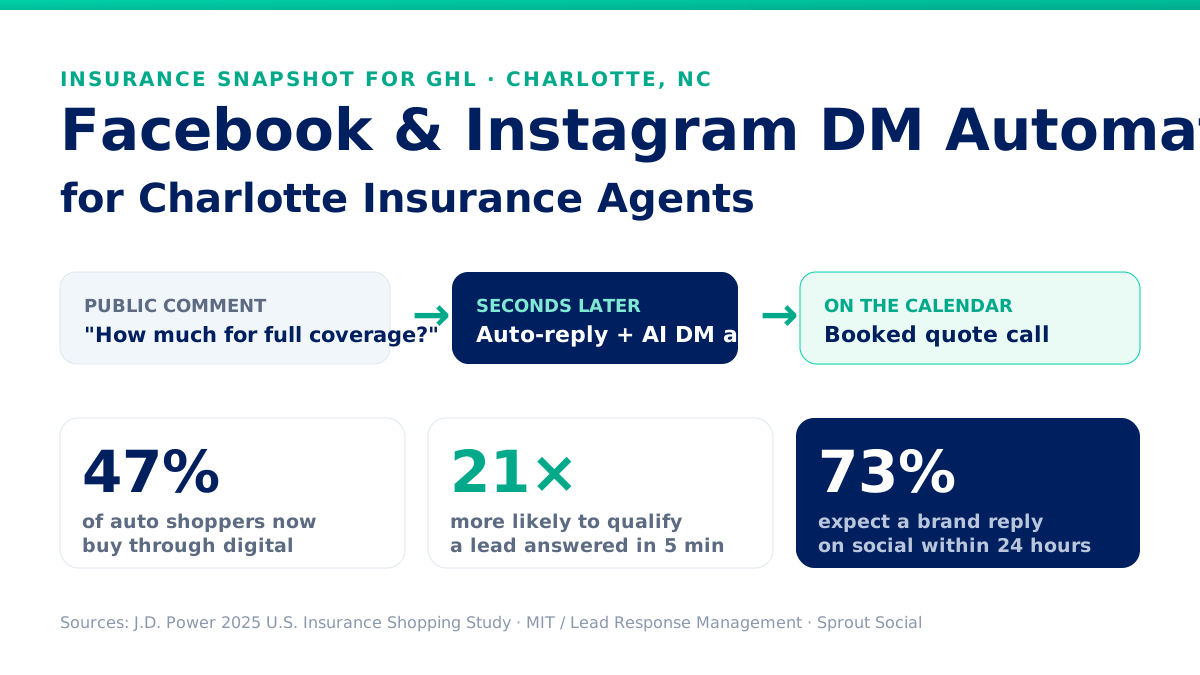
Table of contents
- Why Charlotte agents can’t let a comment go cold
- What comment-to-DM automation actually is
- The speed-to-lead math behind it
- Where your future policyholders already are
- The 6-step playbook: comment to booked quote
- Keeping it compliant: TCPA, Meta, and CMS
- DIY vs. done-for-you
- FAQ
Why Charlotte agents can’t let a comment go cold
Charlotte is one of the fastest-growing markets in the country. The metro crossed roughly 2.8 million residents in 2025, among the nation’s top population gainers, and the city itself reached about 964,784 people — now the 14th-largest in the U.S. (Charlotte Urban Institute). Every one of those new arrivals needs auto, renters, home, and eventually life coverage. And they’re shopping the way everyone shops now: on a phone, comparing options before they ever pick up the call.
The numbers back that up. 57% of auto insurance customers actively shopped their policy in the past year — the highest rate J.D. Power has recorded in 19 years — and 47% now buy through a digital channel, ahead of the 35% who buy through an agent (J.D. Power, 2025). McKinsey puts the digital footprint even higher: more than 80% of insurance shoppers touch a digital channel at least once during their journey (McKinsey).
So when a Charlotte prospect drops “does this cover a teen driver?” under your Instagram reel, that’s not a vanity metric. That’s a shopper mid-journey, raising their hand in public. The only question is who answers first — and whether it’s you.
What comment-to-DM automation actually is
Comment-to-DM automation is a workflow that turns public social engagement into private, qualified conversations without a human watching the notifications. It has three moving parts, and the done-for-you social media system we build for insurance agencies runs all three:
- A comment agent watches your Facebook, Instagram, and TikTok posts and replies to comments in your agency’s voice — so “how much for full coverage?” never sits cold under a reel. High engagement is also exactly what the algorithm rewards with more reach, so fast public replies compound.
- A DM agent picks up the conversation in Facebook Messenger and Instagram DMs — the Instagram DM and Facebook Messenger automations — where it qualifies the prospect (line of business, ZIP, current carrier, coverage need), captures their contact info and consent, and books a quote consultation.
- A booking + handoff layer drops the appointment onto a producer’s calendar through appointment automation and hands off a warm, pre-qualified lead, then keeps nurturing anyone who isn’t ready yet over consent-based SMS.
The point is not to replace your producers. It’s to make sure the first thirty seconds — the part humans reliably miss on nights, weekends, and busy binding days — happens every single time.
The speed-to-lead math behind it
Here’s the uncomfortable data that makes this a priority instead of a nice-to-have. In the MIT / Lead Response Management study of inbound leads, contacting a web lead within 5 minutes versus 30 minutes made a firm 21× more likely to qualify the lead, and 100× more likely to even reach the person (Lead Response Management).
Now compare that to how businesses actually behave. Harvard Business Review’s audit of thousands of U.S. companies found that only 37% respond to an online lead within an hour, 24% take more than a day, and 23% never respond at all (Harvard Business Review). Firms that did reach out within the first hour were nearly 7× more likely to qualify the lead than those that waited even one hour longer.
The gap between “reply in seconds” and “reply tomorrow” is the entire ballgame — and a social comment is even more perishable than a form fill, because the shopper is actively scrolling past a dozen other agents while they wait.
How U.S. auto insurance shoppers buy their policy (%). Nearly half now purchase through a digital channel — the reason a fast reply inside the channel they’re already in wins the quote. Source: J.D. Power 2025 U.S. Insurance Shopping Study.
The lesson for a Charlotte agency isn’t “hire someone to refresh the Instagram app all day.” It’s to automate the reflex — so the reply is instant whether it’s 2 p.m. on a Tuesday or 11 p.m. on a Sunday.
Where your future policyholders already are
You don’t get to pick the channel; your prospects already did. Pew Research Center’s November 2025 data shows how U.S. adults distribute across platforms — and why Facebook and Instagram are the two that matter most for a local agency’s DMs.
Share of U.S. adults who use each platform, 2025. Facebook (71%) and Instagram (50%) are the DM-native platforms where a comment-to-DM flow captures the most local shoppers. Source: Pew Research Center, Americans’ Social Media Use 2025.
71% of U.S. adults use Facebook and 50% use Instagram (Pew, 2025) — and both are messaging-first platforms. That’s where the intent shows up. Globally, more than 1 billion people message a business account every week across Instagram, Messenger, and WhatsApp (Meta, via Adweek). Insurance is a considered purchase, and DMs are where the considered questions get asked: “will this cover my new roof?” “can I add my daughter?” “what’s the deductible on that?”
The catch is the clock. 73% of consumers expect a brand to respond on social within 24 hours (Sprout Social) — and for a shopper comparing quotes, 24 hours is a lifetime. Comment-to-DM automation is how you meet that expectation at the speed the platform actually moves.
The 6-step playbook: comment to booked quote
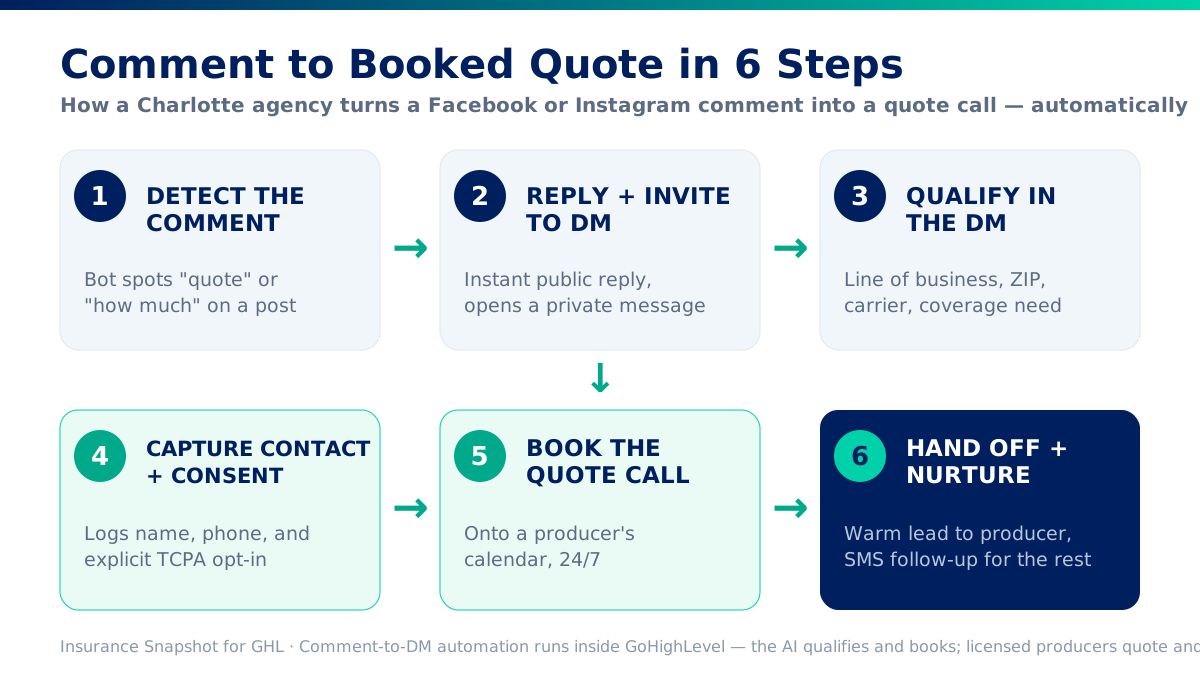
Here’s the exact flow we wire up inside GoHighLevel for an insurance agency. Each step is automated, but every step is also built to respect consent and hand off cleanly to a licensed producer.
Step 1 — Detect the comment
The comment agent monitors your posts, reels, and ads for intent keywords — “quote,” “how much,” “cost,” “coverage,” “rate,” “add a driver,” “bundle.” When it sees one, the workflow fires instantly instead of waiting for a human to notice. On a reel that’s getting reach across Charlotte, that could be dozens of comments a day; none should sit unanswered.
Step 2 — Reply publicly, then invite to a DM
The agent posts a short, on-brand public reply — “Great question! Rates depend on your vehicle and ZIP. I’ll send you a quick DM so we can get you an accurate number.” — and simultaneously opens a private message. The public reply does two jobs: it answers the person, and it signals to everyone else reading that your agency responds fast. That visible responsiveness is a quiet trust builder in a market where most agents go quiet after posting.
Step 3 — Qualify inside the DM
In the DM, the agent asks the handful of questions a producer would ask first: which line of business, ZIP code, current carrier and renewal date, and what coverage they’re after. It answers common questions along the way — the same job the website AI chat widget does on your site, but native to Instagram and Messenger. By the time a human is involved, the lead is already scoped.
Step 4 — Capture contact and consent
Before anything moves off-platform, the DM collects a name, phone, and email — and captures explicit consent to be contacted by text and call. This is the compliance hinge: no phone number gets texted without a clear, logged opt-in. (More on that in the compliance section below.)
Step 5 — Book the quote call
With the prospect qualified and consented, the agent offers real calendar slots and books the quote consultation directly onto a producer’s calendar through appointment automation — with reminders and no-show recovery attached. If your Google Calendar is synced, the appointment shows up on the calendar the team already lives in. No back-and-forth, no double entry.
Step 6 — Hand off and nurture the rest
The producer receives a warm, pre-qualified lead with the full DM context. Anyone who doesn’t book right away enters a consent-based SMS follow-up cadence — the same speed-to-lead discipline you’d apply to a form fill — so a “just looking” today can become a bound policy next week instead of a forgotten thread.
Keeping it compliant: TCPA, Meta, and CMS
Automation that ignores compliance is a liability, not an asset. Three sets of rules apply, and the workflow above is built around them.
- TCPA. Before any automated text or call, you need prior express written consent for marketing messages, plus working STOP/HELP handling. The DM captures and logs that opt-in explicitly at Step 4 — the same standard we hold every TCPA-safe SMS flow to. No consent, no text.
- Meta’s platform rules. Instagram and Messenger have messaging windows and policy limits on automated outreach, and they don’t allow spammy comment blasting. Compliant comment-to-DM stays inside those windows: it responds to people who engaged first, rather than cold-messaging strangers.
- CMS Medicare-marketing rules. If you write Medicare, automated social conversations touching MA/PDP are subject to CMS marketing guidelines, including disclaimer and scope-of-appointment requirements. Keep Medicare DMs on a separate, carefully scripted track — don’t let a general auto-quote bot wander into Medicare advice.
DIY vs. done-for-you
Could a Charlotte agency build this themselves? Technically yes — GoHighLevel, Meta’s messaging APIs, and a lot of trial and error. Practically, here’s the honest trade-off.
| DIY comment-to-DM | Done-for-you (Insurance Snapshot) | |
|---|---|---|
| Time to live | Weeks of building, testing, and fixing broken triggers | Deployed with your social system, tuned for insurance |
| Content to engage with | You still have to produce posts and reels to earn comments | 5 posts/week across 9 channels, insurance-specific |
| Compliance scripting | You own every TCPA/Meta/CMS edge case | Consent capture and guardrails built into the flow |
| Voice & qualifying logic | Generic bot answers, easy to sound off-brand | Written in your agency voice, insurance qualifying questions |
| Monthly cost | Your team’s hours + tooling | From $397/mo, white-label |
For most agencies, the math favors done-for-you — not because the tools are impossible, but because the content engine that feeds the automation (the reels and posts that earn the comments in the first place) is the real work. Comment-to-DM automation only pays off if there’s something to comment on. That’s why we bundle the content and the agents together rather than selling a bot with nothing to answer.
If you’d rather see the full picture first, the Insurance Snapshot for GHL installs the broader operations engine — AI caller, quote funnels, renewal cadences — and you can book a walkthrough to map it to your agency. Agencies that also want paid demand can pair this with Facebook & Meta lead ads, and anyone building an organic footprint should start with the 2026 organic social playbook.
FAQ
What is comment-to-DM automation for an insurance agency?
It's a workflow that detects a coverage question in your Facebook or Instagram comments, replies in your agency's voice, moves the conversation into a private DM, qualifies the prospect (line of business, ZIP, carrier, coverage), captures contact and consent, and books a quote consultation onto a producer's calendar — automatically, 24/7.
Is automated DM outreach TCPA compliant?
It can be, when it's built correctly. The DM captures explicit, logged consent before any automated text or call, and includes STOP/HELP handling. It responds to people who engaged first rather than cold-messaging strangers, which also keeps it inside Meta's platform rules. Medicare conversations follow CMS marketing guidelines on a separate scripted track.
Will the AI quote or bind policies?
No. The agents qualify prospects, answer general questions, and book appointments. They never quote binding premiums, give coverage advice, or make policy decisions — all of that stays with your agency's licensed producers under their own E&O, carrier appointments, and state license.
How fast does it reply to a comment or DM?
In seconds, around the clock. That speed is the whole point: contacting a lead within 5 minutes instead of 30 makes a firm 21× more likely to qualify it (MIT / Lead Response Management), and 73% of consumers expect a social reply within 24 hours (Sprout Social).
Does this work for a Charlotte agency specifically?
Yes. Charlotte's metro passed ~2.8 million residents in 2025 and 47% of auto shoppers now buy digitally (J.D. Power 2025), so a fast reply inside Facebook and Instagram — where 71% and 50% of U.S. adults respectively spend time (Pew 2025) — captures local shoppers your competitors let go cold.
How much does done-for-you comment and DM automation cost?
Our done-for-you social media system starts at $397/mo for a single brand and includes 5 posts a week across 9 channels plus three AI agents (comments, DMs, and web chat). It's white-label, so GHL agencies can resell it to their own insurance clients.
About the author
Priya Raman is an Insurance Agency Growth Strategist who works with independent and captive agencies on turning an existing book into recurring cross-sell revenue and getting more households to a second and third policy. She came up running marketing for a multi-line agency, so she thinks in terms of premium written, retention by line, and producer capacity rather than vanity open rates. She writes about the strategy layer of insurance automation — which workflows actually pay for themselves and how to measure whether any of it is working.
Related posts
- Speed-to-Lead for Insurance Agencies: Answer Every Quote in Seconds
- Social Media Marketing for Insurance Agents: The 2026 Organic Growth Playbook
- AI Chat Widget for a Miami Insurance Agency: Turn Website Visitors Into Booked Quotes
- Facebook & Meta Lead Ads for Insurance Agencies (2026)
- TCPA-Safe SMS for Insurance Agencies
Want the comment-to-quote machine in this post without building it? See our done-for-you social media plans, book a walkthrough, or see what’s inside the Insurance Snapshot for GHL.