
It is 6:50pm on a Thursday and you are still quoting a commercial renewal that should have gone out Monday. The book is growing, the phone keeps ringing, and you are the bottleneck on every account. So you think the thing every principal eventually thinks: I need to hire a producer. Then you remember the last one: eighteen months of salary and your time, and they walked with barely a book to show for it.
Here is the answer up front: a producer is the most expensive and most failure-prone hire a small agency makes, and the agencies that get it right treat it as a two-to-three-year investment, not a Q4 fix. Most new producers never validate. You beat the odds by deciding exactly what you are buying, building the pay plan before you write the ad, screening for sales instinct over insurance resumes, and running a real onboarding instead of handing someone a login and a phone.
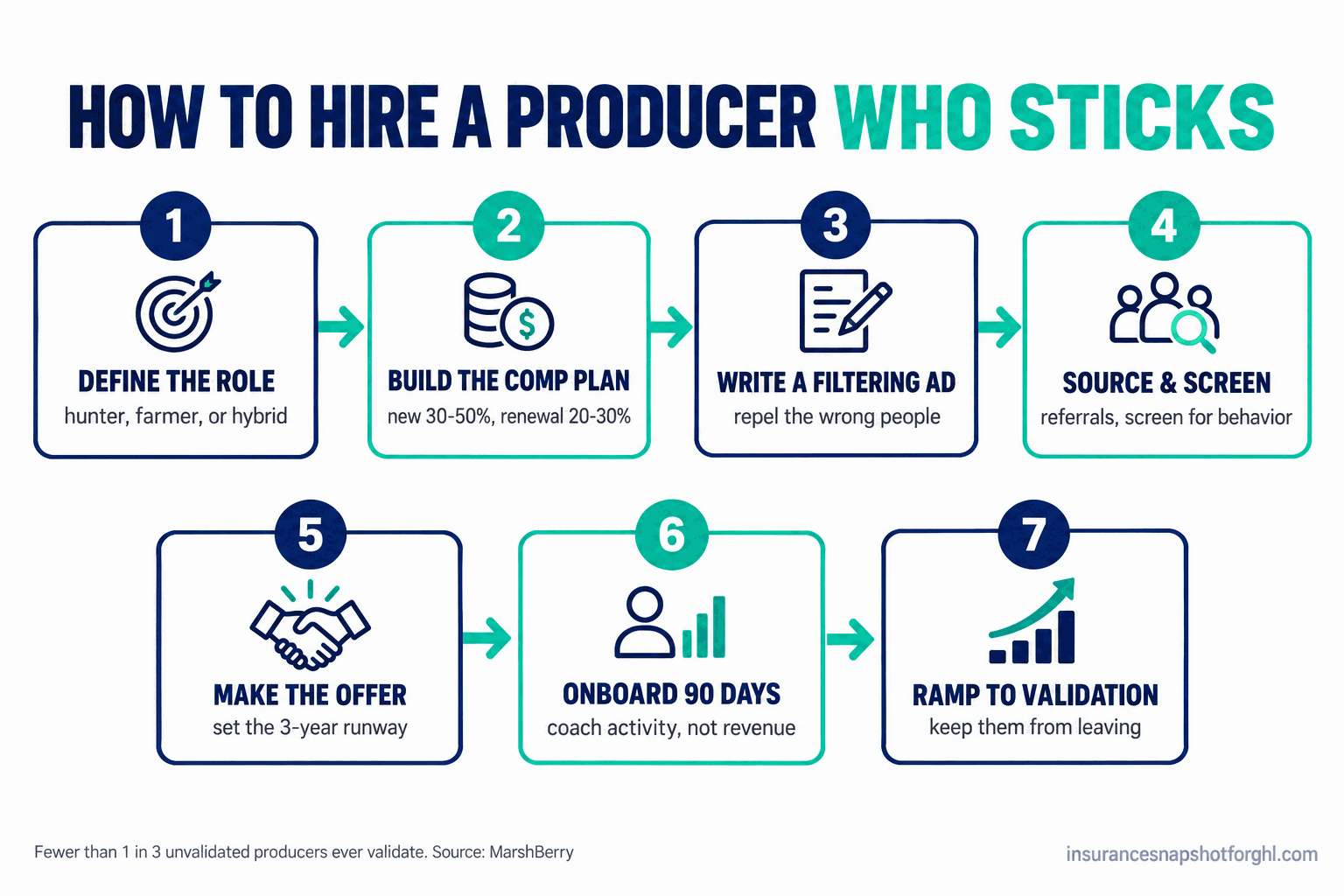
Table of contents
- Why a producer hire is the riskiest money you spend
- Stage 1: Decide what you are actually hiring
- Stage 2: Build the comp plan before the job ad
- Stage 3: Write a job ad that filters (steal this)
- Stage 4: Source and screen (steal these questions)
- Stage 5: Make the offer and set the runway
- Stage 6: Onboard the first 90 days (steal this plan)
- Stage 7: Ramp to validation and keep them
- Solo, five-producer, and large
- The compliance layer you cannot skip
- Objections
- The agency you built
- FAQ
Why a producer hire is the riskiest money you spend
Start with the math. A producer new to the industry takes roughly three years to validate, meaning to write enough new commission to cover their own cost (MarshBerry). For those three years you pay a base or draw, benefits, E&O, and your own time. The median insurance sales agent earns about $60,370 a year (BLS, May 2024), and a new producer’s base plus draw lands near there before they write a dollar.
Then the failure rate: fewer than one in three unvalidated producers ever validate (MarshBerry). The base case is not “ramps slowly,” it is “costs me money for two or three years, then leaves.”
The upside is why you keep coming back to it. Independent agents place 61.5% of all U.S. property and casualty premium (Insurance Journal), and a producer who validates builds a renewable book that pays every year, at the roughly 84% retention an independent agency averages (2026 Independent Agency Growth Study, Liberty Mutual). The job is to stop funding the 70% who wash out.
Independent-agency share of U.S. P&C premium by segment, 2024. Commercial lines, where a validated producer builds the most durable book, are where the channel dominates. Source: Insurance Journal / Big “I” and Future One 2025 Market Share Report.
Stage 1: Decide what you are actually hiring
First, make sure a producer is even the right fix. If half your week is rekeying quotes and reviving cold web leads, a new hire inherits that same swamp and never sells, so fix capacity first by automating the renewal cadence and quote follow-up (our renewal-reminders guide and speed-to-lead playbook cover it). If you do hire, “producer” is three different jobs. Pick one before you write.
The hunter (new business) prospects and writes new accounts: high upside, slow start, hardest to find, the only role that actually grows the agency, and the one with the three-year runway. The farmer (account manager who sells) services and grows an existing book and cross-sells the households you already have: faster payback, lower ceiling, often a better first hire for a solo shop. The hybrid handles personal-lines service and writes small commercial on the side: useful, but honestly two jobs, so pay for both.
Write down which one, the lines, the book they inherit, and the number that defines success at year one and year three.
Failure mode: hiring “a producer” with no definition, then being surprised they service all day and never prospect. Undefined roles default to the path of least resistance, which is always service.
Stage 2: Build the comp plan before the job ad
The pay plan decides who applies and whether they stay. Build it first. Three structures cover almost every small agency:
| Structure | How it works | Best for | Risk |
|---|---|---|---|
| Salary + commission | Steady base plus a modest split on what they write | A first hire who needs security; a hybrid | You carry the base through the lean years |
| Draw against commission | An advance you recover from future commissions | An experienced producer confident in their pipeline | If they never validate, you may be owed a draw you cannot recover |
| Commission-only | No base; they live on splits from day one | Veterans bringing a portable book | Almost nobody good takes it without a starting book |
Then set the split. New-business producer splits commonly run 30% to 50%, with renewal splits lower, often 20% to 30%, so the agency keeps the renewal stream that funds the operation and owns the client and the E&O. Put the numbers in the offer; renegotiating a split after business is written is where partnerships go to die. Finally, define validation and tie the move toward a higher commission share to hitting it.
Share of unvalidated insurance producers who eventually validate, per MarshBerry (about 29.8%, rounded here). Build the comp plan and ramp around this reality, not a best case. Source: MarshBerry, “Solving the Challenge of Non-Producing Producers”.
Failure mode: promising a generous split verbally and sorting out “the details” later. Vague comp attracts people shopping for the most generous-sounding offer and repels the disciplined producer who wants to know exactly how they get paid.
Stage 3: Write a job ad that filters (steal this)
A good job ad repels the wrong people on purpose. Most read like a benefits brochure and pull in every job-hopper in the market. You want one that attracts the person who reads “year one is mostly building a book from scratch” and thinks good.
Failure mode: an ad that promises warm leads and no prospecting. It fills your inbox with order-takers, and the one hunter who would have thrived scrolls past.
Stage 4: Source and screen (steal these questions)
The best producers are rarely on a job board. Work your referral network first: ask your carrier reps and best clients who they would hire if they had the slot. Then screen for behavior, not lines of business. An insurance resume says they can pass a licensing exam, not whether they will pick up the phone on a Friday. Hire the instinct and teach the insurance.
Then do what most agencies skip: a short live role-play. Hand them a prospect calling for an auto quote, or a renewal with a rate increase, and have them run it. Five minutes tells you more than an hour of answers; our renewal scripts post has one you can use.
Failure mode: hiring the most impressive interviewer. Producers are good at talking by definition, and the role-play cuts through the polish to whether they will do the unglamorous daily work.
Stage 5: Make the offer and set the runway
Put everything in writing: base or draw, the exact splits, the validation target and timeline, benefits, book ownership if they leave, and the legal shape of the relationship (below).
Set runway expectations honestly. If validation takes about three years (MarshBerry), a producer who expects to be rich in year one is demoralized by month eight and gone by month fourteen. Tell them year one is hard and mostly prospecting, year two the book compounds, year three is when it pays. The candidate who stays excited is the one who validates.
Failure mode: overselling year one to close the candidate. You win the hire and lose the producer, because reality arrives in month three and never matches the pitch. Undersell year one slightly.
Stage 6: Onboard the first 90 days (steal this plan)
The first 90 days decide more than the next three years. A producer handed a login and “go sell” drifts into servicing because servicing feels productive; a structured ramp builds habits that compound instead. Run this as-is.
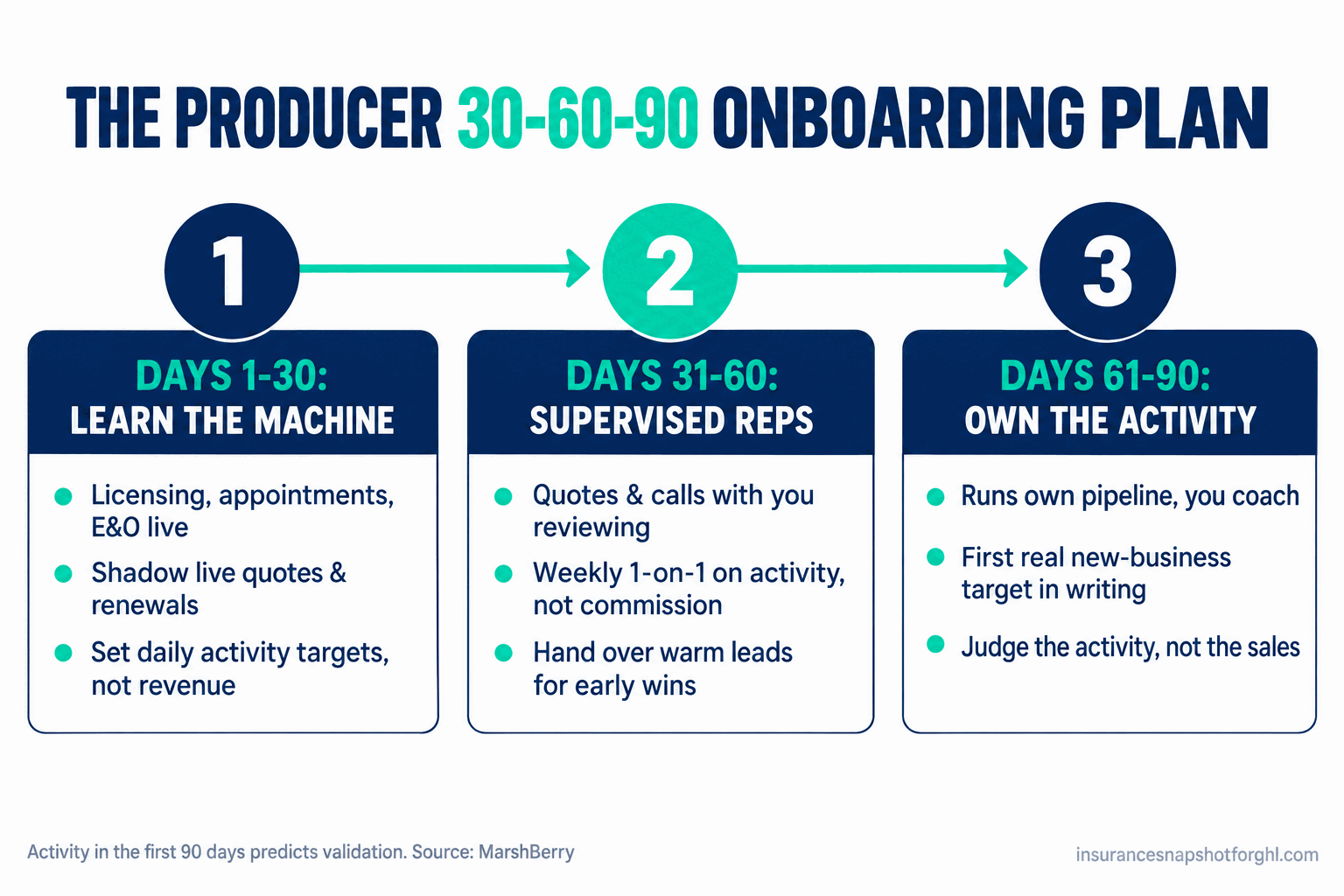
Protect their selling time. If renewal admin lands back on their desk, the ramp stalls, so keep the renewal cadence on autopilot.
Failure mode: measuring commission in month two. There is none. Judge a ramping producer on revenue instead of activity and you fire a good hire too early or let a lazy one hide behind “the market is slow.”
Stage 7: Ramp to validation and keep them
Months four through thirty-six are where producers are won or lost. Keep three things steady.
Coach the activity, every week. A standing one-on-one on pipeline and activity is the difference between a producer who compounds and one who drifts, because consistent prospecting shows up in the pipeline months before it shows up in the book.
Make staying better than leaving. Good producers walk for one of two reasons: the comp plan stopped making sense as the book grew, or they stopped feeling like they were building something of their own. Revisit the split at validation as promised, and be clear about book ownership and a path to equity.
Failure mode: winning the hire and neglecting the ramp. Hiring is the first 5% of the job. The agencies that say producers never work out usually hired well and then abandoned the person in month five.
Solo, five-producer, and large
The playbook is the same. The right first move is not.
The solo operator. Your real problem is usually capacity, not headcount. Before a hunter, consider a farmer who relieves you immediately, or automation and a VA that give back selling hours without a three-year bet. If you do hire, you are the only coach, so protect that weekly one-on-one.
The five-producer agency. You can absorb a longer runway, so a true hunter makes sense. Your risk is onboarding by osmosis: assign one experienced producer as coach, run the 30-60-90 formally, and give the new hire a defined slice of leads.
The larger agency. Your constraint is consistency. Build the 30-60-90 and activity metrics into your pipeline so every producer gets the same ramp and you see in month three who is on track. At scale, the ones you lose quietly stalled where nobody was watching.
The compliance layer you cannot skip
A producer hire carries legal weight a marketing hire does not. None of this is legal advice, so confirm specifics with your attorney and state insurance department.
Licensing and appointments. A producer cannot sell until they hold the right resident (and any non-resident) license and are appointed with the carriers whose products they write. Confirm license status and start appointments before day one; state producer rules live with your department of insurance and the NAIC.
Worker classification. W-2 employee or 1099 contractor is a legal test based on how much you control the work, and getting it wrong creates tax and penalty exposure. A ramping producer on your book, your systems, and your supervision usually looks like an employee, so check the IRS guidance on worker classification.
Book ownership and non-piracy. Write down who owns the book if the producer leaves, and have counsel draft any non-solicitation language. Non-competes vary by state, so lean on protecting the book rather than barring someone from working.
Anti-rebating binds the clients they write. Gift limits vary by state (Florida caps client gifts at $100 a year, Texas at $25), and TCPA governs their texting. Our marketing compliance guide covers those lines.
Objections
“I can’t afford to carry someone for three years.” Then do not start with a commission-only gamble or an expensive hunter. Free capacity with automation or a part-time VA so your own selling hours grow, or hire a farmer who produces while they service and pays back faster.
“Can’t I just hire an experienced producer with a book?” Sometimes, but a truly portable book is rarer than it sounds, and a producer who left one agency with their clients may do it to you. Vet the portability and the legal strings first.
“How do I know in month six whether this is working?” Watch activity, not commission. Quotes out and follow-ups predict validation before the book does. A producer hitting activity targets is on track even with little revenue; one who is not is already telling you how this ends.
The agency you built
Picture the same Thursday a year from now. It is 5:30pm and you are leaving on time, because the renewal went out on autopilot and the producer you hired spent the day talking to prospects and clients instead of fighting paperwork. They are not validated yet, but the activity is there and you are no longer the bottleneck on every account.
A producer hire goes wrong when you treat it as a quick fix and leave the person to figure it out alone. It goes right when you clear the busywork first, decide exactly what you are buying, pay for it deliberately, and coach the ramp. Do that and you build the renewable book that pays for years instead of funding the washouts. Read the 2026 customer retention playbook and the speed-to-lead playbook next.
How long does it take a new insurance producer to become profitable?
Validation, the point where their book covers their full cost, typically takes about three years for a producer new to the industry, per MarshBerry. A portable book or a service-plus-sales role can pay back sooner.
What is a typical commission split for a new producer?
New-business producer splits commonly run 30% to 50%, with renewal splits lower, often 20% to 30%, so the agency keeps the renewable stream. Exact numbers vary, so decide them in writing before you make an offer.
Should I hire a producer or a virtual assistant first?
If your week is full of renewal admin, quote follow-up, and cold web leads, much of what feels like a producer problem is really a capacity problem. Automation or a trained VA is faster and cheaper than a three-year producer bet.
What is the biggest reason new producers fail?
Usually two things together: they spend their ramp on service and admin instead of prospecting, and they get no real coaching. MarshBerry finds fewer than one in three unvalidated producers ever validate.
Should a producer be a W-2 employee or a 1099 contractor?
It is a legal test based on how much you control the work, not a preference. A ramping producer who sells your book on your systems under your supervision usually looks like a W-2 employee, and misclassifying creates tax and penalty exposure, so confirm with your accountant.
Related posts
- Insurance Customer Retention: The 2026 Playbook to Stop Policy Churn
- Speed to Lead for Insurance Agencies: The 5-Minute Rule That Wins More Policies
- How to Automate Insurance Renewal Reminders Without Upgrading Your AMS
- The Renewal Cadence That Actually Works (120 / 60 / 30 / 7)
- Insurance Renewal Scripts: What to Say When the Premium Jumps