
It is a Thursday afternoon and a voicemail is waiting from a client you bound two years ago. Their basement flooded, they filed a claim, and the carrier denied it because the water-backup coverage they swear they asked for was never on the policy. Now they want to know who is going to pay for the $18,000 in damage, and the way they say your name tells you they already think they know.
Here is the answer up front. For a small independent agency, E&O (errors and omissions, also called professional liability) is not optional, and the common $1 million per claim floor that gets you appointed is rarely the number you actually want to carry in 2026. Think of $1M per claim / $1M aggregate as the entry point, step up to $1M/$3M or higher as premium volume and commercial lines grow, and treat the policy as the backstop, not the plan. The real protection is documentation, because the single most common claim is not fraud or incompetence, it is a client saying “I asked for that coverage” when nothing in the file proves otherwise.
This is general education, not legal or coverage advice; your E&O carrier, broker, and state set the actual requirements.
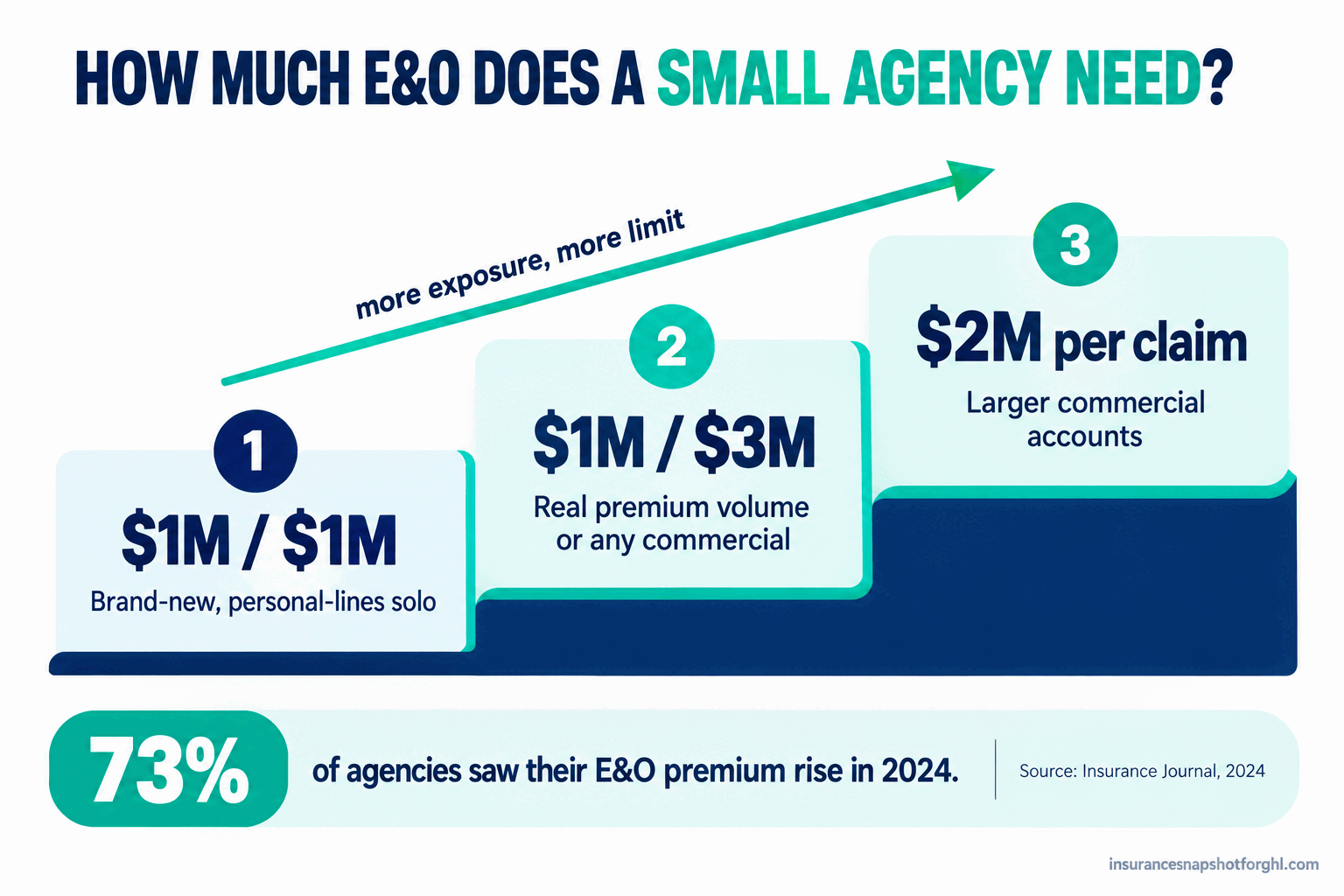
Table of contents
- What E&O actually is, and why carriers make you carry it
- How E&O coverage actually works (claims-made, limits, the tail)
- How much do you actually need in 2026?
- How agency E&O claims actually happen
- Steal this: the documentation that wins the claim
- What E&O actually costs a small agency
- Solo, five-producer, and larger: who needs what
- Where automation fits
- Objections
- The voicemail you never get
- FAQ
What E&O actually is, and why carriers make you carry it
E&O covers you when a client claims your professional work cost them money: you failed to get a coverage they asked for, you let a policy lapse, you gave them the wrong limit, or you did not explain an exclusion that later bit them. It is not general liability or cyber; it is the policy that answers “the agency made a mistake, who pays?”
You carry it for two reasons. First, you will at some point be accused of a mistake, whether you made one or not. Second, you usually do not get a choice: few states mandate E&O for every agent by law, but nearly every carrier appointment agreement requires it, commonly at a $1M minimum, before they appoint you. No E&O, no appointments. No appointments, no agency.
The stakes are not small. Independent agents placed 61.5% of all U.S. property and casualty premium in 2024 (Insurance Journal), so shops like yours make the coverage decisions that end up in dispute. And those disputes are getting more expensive: the Swiss Re Institute found U.S. liability claims rose 57% over the past decade, driven largely by litigation costs and social inflation (Swiss Re Institute).
How E&O coverage actually works (claims-made, limits, the tail)
A few mechanics trip up almost every agency owner the first time.
It is claims-made, not occurrence. Home and auto policies are occurrence-based: if the event happened while the policy was in force, you are covered even if the claim shows up years later. E&O is the opposite. The policy that pays is the one in force on the day the claim is filed, not the day you made the mistake. Let your E&O lapse for a month, have a claim land on a mistake from two years ago, and you may have no coverage at all. That is why you never let it gap.
The retroactive date decides your past. The policy only covers mistakes made on or after its retroactive date. When you switch carriers, you want that date to stay the same (your “prior acts” coverage), not reset to today. A reset retro date quietly wipes out coverage for everything you did before the switch, so check it every time you re-shop.
Per claim versus aggregate. A $1M/$1M policy pays up to $1 million for any single claim and $1 million total across the year, so if one claim eats the full $1M, nothing is left for a second that year. A $1M/$3M policy keeps the $1M per claim but gives you $3 million across the year. The Big “I” Virtual University has a plain-language breakdown of what E&O limits mean for an agency.
The tail. Because coverage is claims-made, when you retire, sell, or switch carriers you may need an Extended Reporting Period (the tail) to cover claims filed after your policy ends on work done while it was active. A tail typically costs 100% to 300% of your annual premium (IIAT E&O loss-control guidance), so if you plan to sell your book, it is part of the exit math.
How much do you actually need in 2026?
Start with the floor and argue yourself upward. The $1M per claim / $1M aggregate policy is the common entry point and the number most carriers accept to appoint you, and for a brand-new personal-lines solo it may be enough for year one. But three things push you past the floor fast, and all three are moving the wrong way:
Your premium volume. The bigger the book, the bigger the potential mistake. An agency placing $4,200 homeowners policies and $30,000 commercial packages is exposed to far larger claims than one writing $600 renters policies.
Your mix of lines. Commercial lines are where the big E&O claims live: bigger dollar figures, more complex coverage. The moment you write commercial property, general liability, or anything with a professional component, the $1M floor looks thin. Life and annuity work adds its own advertising and suitability exposure under the NAIC advertising model regulation.
The cost of claims is rising. E&O renewal premiums climbed for a third straight year, with 73% of agencies reporting an increase in 2024, up from 63.5% the year before, and 69% expecting another hike (Insurance Journal Agency E&O Report 2024). A limit that was comfortable in 2020 is a smaller cushion now.
Share of agencies reporting an increase in their E&O renewal premium, 2023 vs 2024. The trend is the argument for carrying more than the bare minimum. Source: Insurance Journal Agency E&O Report 2024.
The jump from $1M to $3M aggregate usually costs far less than expected, because the upper layers are low-probability, so price it before you assume you cannot afford it.
How agency E&O claims actually happen
You do not get sued for being a bad person. You get sued for the gap between what the client thought they had and what the policy actually said. Here is how that gap opens, and how to close it.
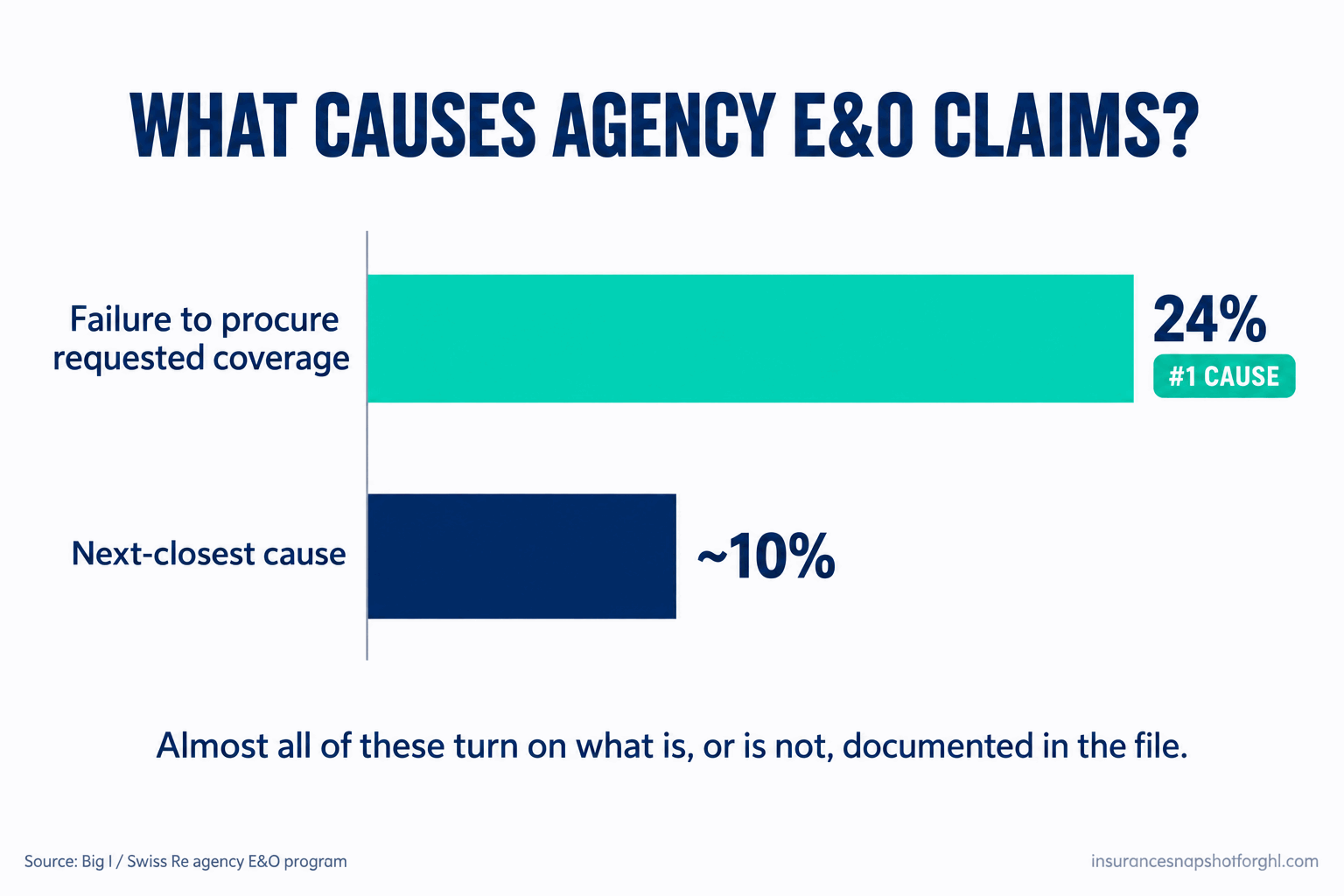
Failure to procure the requested coverage. The number one agency E&O claim, roughly one in four, and the next most common cause is less than half as frequent (IA Magazine). A client asks for a coverage, it never makes it onto the policy, a loss hits the gap, and it is your word against theirs. How to close it: confirm every request and change in writing, same day. Never rely on a verbal “yeah, add that.”
The silent coverage reduction. You move a client to a cheaper policy and quietly drop a coverage they had, water backup, ordinance-or-law, a higher dwelling limit, without flagging it. The claim lands in that gap and the client says they never agreed to less. How to close it: when a new policy differs from the old one, put the difference in writing and get an acknowledgment before you bind. This is also the trap in a carrier non-renewal re-placement, where it is easy to match price instead of coverage.
The lapse. A renewal falls through the cracks, a payment is missed, a policy cancels, and nobody tells the client in time. A loss during the gap is now your problem. How to close it: an automated renewal and payment cadence, not one that depends on a person remembering. Our renewal cadence that actually works covers the 120/60/30/7-day structure.
The declination you cannot prove. A client turns down umbrella coverage or a higher limit, has a loss that blows past it, and does not remember declining. How to close it: a signed declination, which has ended more E&O claims than any policy language ever will.
Steal this: the documentation that wins the claim
Every failure mode above comes down to one thing: can you prove what happened, with a timestamp? Adapt this language to your agency and state, and have your E&O carrier review your templates.
The rule behind all three: if it is not in the file with a date on it, it did not happen, at least not as far as an E&O defense is concerned. A client’s memory is not evidence; a timestamped record is.
What E&O actually costs a small agency
Most carriers quote E&O individually, based on your revenue, lines, claims history, and limit, so treat the following as provider benchmarks, not a survey.
For a small agency carrying a $1M/$1M limit, annual premiums commonly land around $800 to $3,000, with brand-new solo shops at the low end and agencies near $1 million in revenue running roughly $3,000 to $8,000, climbing with commercial lines, higher limits, and prior claims (Insureon benchmarks).
A few cost levers:
- Deductible. Small agencies commonly carry a $1,000 to $5,000 per-claim deductible. Raising it lowers your premium, but only take on a retention you could cover tomorrow.
- The dedicated program. The Big “I” Professional Liability program, underwritten through Swiss Re Corporate Solutions, is the long-running agents E&O market built for independent agencies, with risk-management resources most generic markets lack.
The cheapest E&O policy is the one you never claim against, which brings us back to documentation. You cannot control the rate environment, only whether a dispute becomes a claim.
Solo, five-producer, and larger: who needs what
The mechanics are the same at every size. What changes is the limit and how you keep the file clean.
The solo operator. You are the producer, service team, and file clerk, so documentation is the first thing that slips when you get busy. Start at $1M/$1M if you are personal-lines only, step to $1M/$3M the moment you add commercial, and automate every confirmation and declination so the paper trail does not depend on you remembering at 6pm.
The five-producer agency. Your risk is inconsistency. One producer documents everything, another binds on a handshake, and you inherit the exposure of your weakest file. Carry $1M/$3M at minimum, more for commercial, and standardize so every producer uses the same confirmation email and declination form. A claim against one producer is a claim against the whole agency.
The larger agency. Your constraint is visibility across volume. With thousands of policies you cannot eyeball whether coverage changes are confirmed. Build documentation into the workflow so it logs automatically, carry limits that match your largest commercial accounts (often $2M per claim or higher), and run periodic file audits. At scale, the claim that sinks you is the one nobody noticed was undocumented until the suit arrived.
Where automation fits
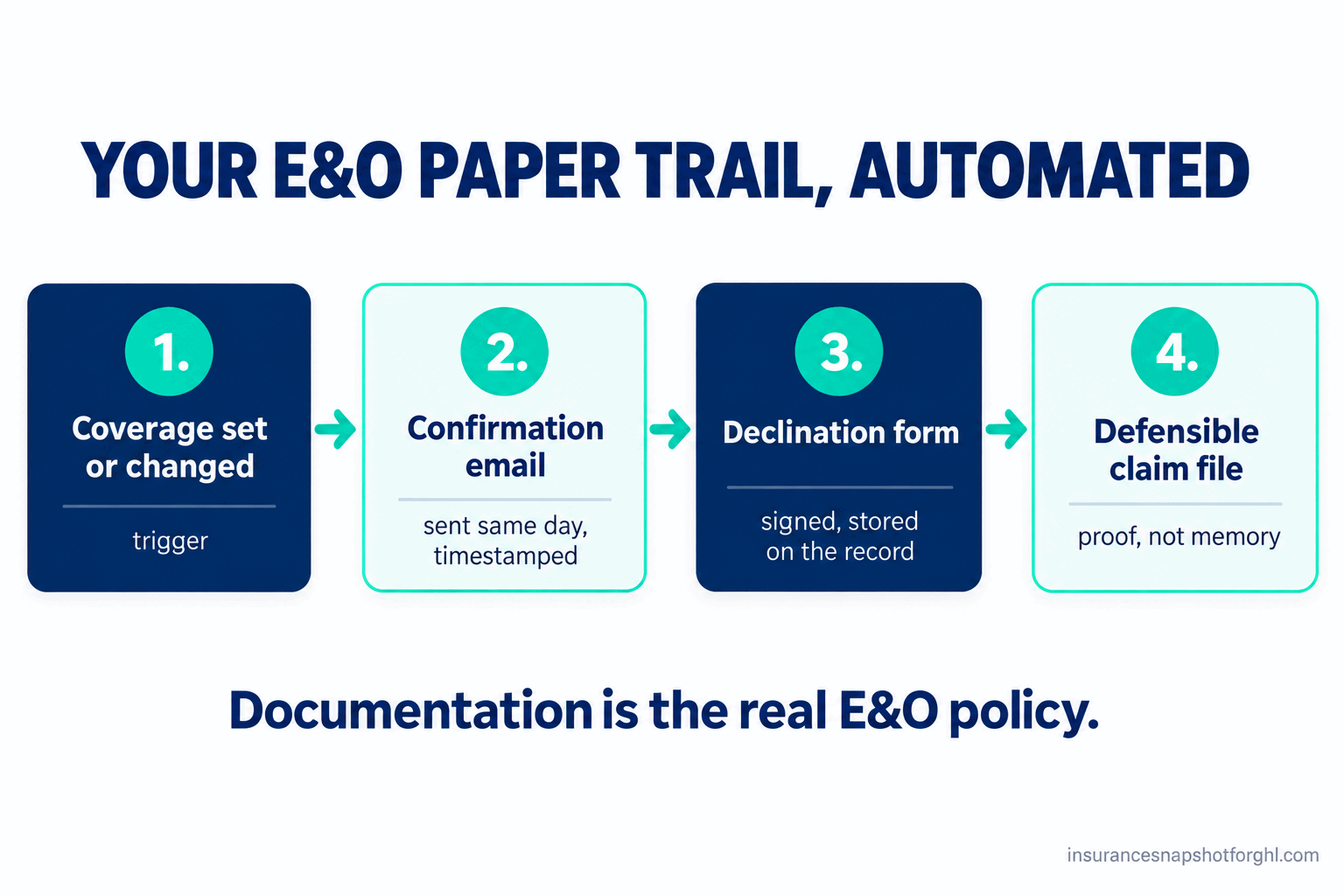
E&O defense and client automation are the same system. When a coverage is set or changed, a workflow fires the confirmation email, timestamps it, and files it against the record. When a client declines a coverage, it sends the declination form and stores the signed copy. Renewals and payments run on a cadence that does not depend on anyone’s memory, which closes the lapse gap, and none of it asks the producer to do anything extra in the moment.
That is the quiet value of a done-for-you setup like the Insurance Snapshot for GHL: sold as a growth engine (renewals, cross-sell, speed to lead), but the same workflows double as the most reliable E&O documentation habit your agency will ever have.
Objections
“I’ve been in business 15 years and never had a claim.” That is survivorship, not strategy. The agencies hit hardest are usually the ones who got comfortable and let documentation slide. And claims-made coverage means your clean years do not protect you from a claim filed tomorrow on last year’s work.
“My carrier only requires $1M, so that’s what I’ll carry.” The carrier requirement is a floor for their protection, not a ceiling for yours. If one claim hits your full $1M and a second lands the same year, a $1M aggregate leaves you personally exposed. A larger aggregate is cheap insurance against a bad year.
“All this documentation will slow my producers down.” Only if you make them do it by hand. The point of automating it is that the producer does nothing extra, the system does. A ten-second workflow trigger today beats a $200-an-hour defense attorney two years from now.
The voicemail you never get
Picture that flooded-basement call again, but this time you open the client’s file and there it is: the confirmation email from the day you bound them, with a dated line noting that water backup was offered and declined. You forward it to your E&O carrier, the claim closes in a week, and the client, still unhappy, has no case against the agency. You never spend a dollar of your limit.
That is the whole game. The limit matters, and in 2026 you should carry more than the bare minimum, but it is the backstop you hope never to use. Documentation is what keeps you from needing it, so build the habit into a system that runs whether you remember or not.
Read the 2026 customer retention playbook and the client onboarding system next, both built on the same documented-every-step discipline, plus the 2026 insurance agency statistics for the numbers behind the channel.
FAQ
Is E&O insurance legally required for insurance agencies?
In most states it is not a universal legal mandate for every agent, but it is effectively required anyway, because nearly every carrier appointment agreement makes you carry it (commonly at a $1 million minimum) before they appoint you. Some states and associations impose their own requirements, so check your state and your carrier agreements.
How much E&O coverage does a small insurance agency need?
A common entry point is $1M per claim and $1M aggregate, which is what most carriers accept to appoint you. Most small agencies should step up to $1M/$3M once they have real premium volume or any commercial business, and consider a $2M per-claim limit for larger commercial accounts. The number scales with the coverage decisions you make.
How much does agency E&O insurance cost in 2026?
It varies by revenue, lines written, claims history, and limit. Provider benchmarks put a small agency at a $1M/$1M limit around $800 to $3,000 a year, with agencies near $1 million in revenue running roughly $3,000 to $8,000. Commercial lines, higher limits, and prior claims all push it up.
What is the most common E&O claim against insurance agencies?
Failure to procure the coverage a client requested is the number one cause, roughly one in four agency E&O claims, and far more common than the next cause. It usually comes down to a client saying they asked for a coverage that never made it onto the policy. Same-day written confirmation of every request is the best defense.
What is the difference between per-claim and aggregate E&O limits?
The per-claim limit is the most the policy pays on any single claim. The aggregate is the most it pays across all claims in the policy year. A $1M/$1M policy can be exhausted by one large claim, leaving nothing for a second that year. A $1M/$3M policy keeps $1M per claim but gives you $3M total, which is why most growing agencies step up to it.